For Mohamad, a routine preventive visit turned into a lifesaving discovery. With no symptoms and a perfectly normal prostate-specific antigen (PSA) level of 0.5, he had no medical reason to be concerned about his prostate gland. Yet a family connection and precautionary instinct led him to Dr. Desai at Tower Urology. It was a proactive decision that would ultimately save his life.
“I had no symptoms whatsoever. My PSA was 0.5, so there was no reason for me to do anything or be concerned,” Mohamad recalls. “But a cousin of mine had major problems with his prostate. It had become enlarged, so he was seeing Dr. Desai. I just thought that, as he and I were cousins and we shared the same genes, I might have the same problems down the road.”
When family history prompts proactive prostate screening
Mohamad’s close relative was likely dealing with benign prostatic hyperplasia (BPH), which can be a common condition in aging men. “I thought it would be prudent to consult Dr. Desai to see if there was anything I should be concerned about,” Mohamad explains. “I made an appointment to find out if there were any preventative measures I could take to avoid a similar fate.”
An unexpected discovery through thorough evaluation
What Mohamad expected to be a routine consultation turned into something more serious. Despite his normal PSA blood test, Dr. Desai carried out a thorough physical exam, including a cystoscopy (a procedure to examine the inside of the bladder and urethra) given his urinary symptoms despite medical therapy, and the results indicated cause for concern.
“Dr. Desai checked me out, and he found something on the cystoscopy that needed further investigation,” Mohamad recalls. “He wanted me to have a biopsy of this area that was within my prostate, so I attended Cedars-Sinai for the procedure.”
The biopsy results revealed a very high Gleason score and detected an atypical type of aggressive prostate cancer. “Following this discovery, Dr. Desai advised me to undergo further imaging tests, and when they returned showing no evidence of spread of cancer, he recommended a robotic radical prostatectomy right away,” Mohamad explains.
The prostate gland can be affected by BPH or prostate cancer. While the two conditions can coexist, there is no link between them. Having an enlarged prostate does not put you at risk of prostate cancer.
Treatment options differ, too. For BPH, a simple prostatectomy (also known as transurethral resection of the prostate or TURP), which removes part of the prostate, may be recommended.
Following a cancer diagnosis, a radical prostatectomy might be appropriate, involving the removal of the entire prostate gland, seminal vesicles, and sometimes lymph nodes. However, it is often considered a localized prostate cancer treatment where the disease has not spread beyond the prostate.
Weighing surgical and radiation treatment options
Mohamad explored his treatment options, consulting doctors about radiotherapy as an alternative to surgery.
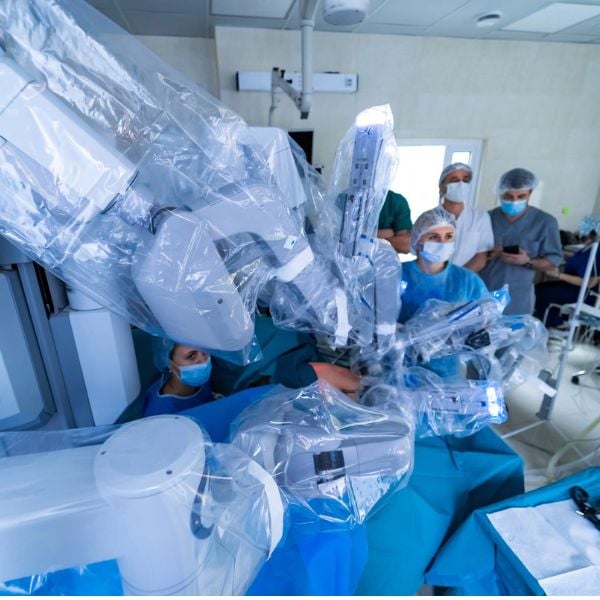
While both surgical procedures and radiotherapy are valid prostate cancer treatment approaches, Dr. Desai discussed the option of robot-assisted laparoscopic radical prostatectomy, which offered Mohamad the possibility of completely removing cancer cells in a single surgical procedure under general anesthesia.
“Dr. Desai explained that the operation would be undertaken in a single day, and then I would be discharged to recover at home,” he explained. “Radiation treatment, on the other hand, was six weeks of therapy, and it might not cure the problem without additional hormone treatment. At that point, I just wanted the cancer eradicated.”
Dr. Desai’s reassuring guidance during diagnosis
“I cannot stress enough how much of a support Dr. Desai was throughout the entire process,” Mohamad says. “He wanted to see me as soon as he got the biopsy results, and he explained that the cancer was aggressive and that I should take swift action to deal with it.”
Dr. Desai’s calm demeanor made all the difference. “It was a real shock and completely unexpected, but Dr. Desai remained calm and reassuring throughout,” Mohamad recalls. “This made it much easier for me to decide to have him carry out the surgery.”
Mohamad’s robotic-assisted laparoscopic prostatectomy exceeded expectations. “The operation itself was a walk in the park. It was totally painless,” he says.
Unlike open radical retropubic prostatectomy, which requires a large incision in the lower abdomen between the navel and the pubic bone, or perineal prostatectomy through the perineum (the area between the scrotum and rectum), the robotic approach involves the surgeon sitting at a console near the operating table and making small incisions using Da Vinci robotic arms for enhanced precision.
“They kept me overnight but discharged me the next day, and I came home with no symptoms, no problems,” Mohamad reports, “I didn’t even have to take a single aspirin!” The minimally invasive nature of this type of surgery results in shorter hospital stays and faster recovery times compared to open surgery or traditional laparoscopic surgery.
“I had a urinary catheter for five or six days,” Mohamad reports, which is standard to drain urine while the bladder neck and urethra connection heals. “After that, I returned to Dr. Desai’s office and had it removed. Since then, I’ve never had any issues with urinary incontinence or sexual function — it’s been a total success.”
Preservation of erectile function and urinary control are top concerns for men considering prostate removal. While side effects like urinary incontinence, erectile dysfunction, and retrograde ejaculation are possible, along with risks such as blood clots or injury to surrounding tissues like the rectum, advances in nerve-sparing robotic surgery techniques have dramatically improved outcomes.
Three years cancer-free with comprehensive follow-up
Regular monitoring (such as blood tests and examinations with a healthcare provider and broader care team) helps ensure early detection if the cancer returns.
“I’ve been cancer-free for three years, but I see an oncologist every three months to make sure it doesn’t reappear,” Mohamad explains. “And I see Dr. Desai every three months to make sure he’s happy too.”
Becoming an advocate for proactive prostate care
Mohamad’s story illustrates an important lesson: sometimes, the most important medical visits are driven by instinct rather than symptoms. “I had absolutely no symptoms,” he emphasizes. Without that proactive visit, Mohamad’s cancer might have progressed undetected, potentially spreading to lymph nodes or other parts of the male reproductive system.
“Since my operation, I’ve referred eight or nine people to Dr. Desai, and he has taken care of all of them,” Mohamad shares. “I’ve heard nothing but praise from my friends about him — he really is an absolute jewel of a guy.”
Why choose Tower Urology for prostate cancer care?
At Tower Urology, our specialists combine thorough evaluation, including physical exams and diagnostic tools like cystoscopy, with state-of-the-art robotic surgery techniques. Our experienced surgeons perform advanced procedures using tools like Da Vinci technology, offering patients the benefits of small incisions, reduced recovery times, and excellent functional outcomes.
Tower Urology is a proud affiliate of Cedars-Sinai Medical Center, ranked #1 in California and #2 nationwide by U.S. News & World Report. This partnership reflects our dedication to delivering the highest standard of urologic care alongside the best urologists in Los Angeles. Our years of experience and access to Cedars-Sinai’s world-class facilities ensure that our exceptional and innovative urological care positions Tower Urology as a leader in Southern California.
Tower Urology is conveniently located for patients throughout Southern California and Los Angeles, including Beverly Hills, Santa Monica, West Los Angeles, West Hollywood, Culver City, Hollywood, Venice, Marina del Rey, Burbank, Glendale, and Downtown Los Angeles.
Our services include comprehensive prostate care, management of lower urinary tract symptoms caused by BPH, advanced prostate cancer treatment, including various types of prostatectomy procedures, and proactive screening for at-risk patients.
If you have concerns about your prostate health, whether related to BPH, elevated PSA, family history, or other risk factors, Tower Urology offers comprehensive evaluation and the latest treatment options.
Frequently asked questions about prostate cancer surgery and robotic prostatectomy

The goal of radical prostatectomy is to remove the entire prostate gland and surrounding tissue to eliminate cancer while preserving urinary control and sexual function whenever possible. Your care team may recommend robotic-assisted or open surgery depending on your health and cancer stage.
Robotic-assisted prostatectomy provides your surgeon with enhanced 3D visualization and instruments that allow more precise dissection around delicate nerves and blood vessels. This precision can improve the recovery of urinary continence and erectile function after surgery.
Most men stay in the hospital for one night. A urinary catheter remains in place for about a week to allow healing. You’ll likely return to light activities within two to three weeks, with full recovery taking a few months. Regular follow-ups and PSA blood tests help monitor for recurrence.
While prostate removal greatly reduces cancer risk, recurrence can occur if cancer cells remain in nearby tissues or lymph nodes. Your doctor will track PSA levels after surgery; an increase may prompt further testing or additional treatment like radiation or hormone therapy.
A PSA test is typically performed between six and eight weeks after surgery to establish a new baseline. Your doctor will continue testing every few months for the first few years, then less frequently if PSA levels remain undetectable.
Sources:
Genetic Predisposition to Benign Prostatic Hyperplasia: Where Do We Stand
https://www.sciencedirect.com/science/article/pii/S266616832401098X
Benign prostatic hyperplasia (BPH)
https://cancer.ca/en/cancer-information/cancer-types/prostate/what-is-prostate-cancer/benign-prostatic-hyperplasia
Prostate Cancer
https://www.ncbi.nlm.nih.gov/books/NBK470550/