What Is Premature Ejaculation? Understanding the Condition, Its Types, and What Drives It
Premature ejaculation (PE) is the most common male sexual dysfunction, affecting an estimated 20–30% of sexually active men across all ages and backgrounds. Yet despite how prevalent it is, many men suffer in silence — often because of embarrassment or uncertainty about where to turn. At Tower Urology in Los Angeles, we provide a safe, confidential space where you can discuss these concerns openly with specialists who understand both the clinical and deeply personal dimensions of this condition.

Clinically, PE is defined as ejaculation that occurs sooner than a man or his partner would like — typically within one to two minutes of penetration — and that causes personal distress or interpersonal difficulty when it happens repeatedly. To measure this precisely, specialists use a clinical benchmark called intravaginal ejaculatory latency time (IELT): the elapsed time from vaginal penetration to ejaculation. Men with PE consistently record an IELT of under two minutes, compared with an average of five to seven minutes in men without the condition. Tracking IELT allows our clinicians to set realistic, measurable treatment goals and monitor your progress with objectivity and care.
Equally important is understanding which type of PE you are experiencing, because the distinction directly shapes the most effective treatment path. Specialists recognize two clinically distinct subtypes:
Lifelong (primary) premature ejaculation has been present since a man’s very first sexual experiences. It is most often rooted in neurobiological factors—specifically, lower serotonin activity, a key neurotransmitter in the brain’s ejaculatory control centers. Because serotonin plays a central role in regulating the ejaculatory reflex, reduced serotonin signaling can significantly shorten the time to climax. This subtype typically responds best to medications that target and enhance serotonin pathways.
Acquired (secondary) premature ejaculation develops after a period of normal ejaculatory control. It is more commonly linked to psychological stressors such as performance anxiety, relationship changes, or an underlying medical condition — including prostatitis or low testosterone. In many cases, addressing the root trigger leads to meaningful improvement or full resolution.
Recognizing which subtype applies to you is not a minor detail — it is the foundation of a treatment plan that actually works. At Tower Urology, we deliver unparalleled expertise and compassionate care, combining advanced diagnostics with a thorough understanding of the neurological, hormonal, and psychological factors at play. PE is highly treatable, and with the right specialist in your corner, lasting improvement is well within reach.
Who Is Affected by Premature Ejaculation?
PE can affect men at any stage of life. It is most frequently reported among younger men, but older men dealing with hormonal changes, prostate issues, or cardiovascular conditions are also at risk. Whether you have struggled with PE since your first sexual experience or it has emerged recently in the context of a new relationship or health change, you are far from alone – and you do not have to manage it without support.
What Causes Premature Ejaculation?
PE rarely has a single cause. Most cases involve a complex interplay of biological and psychological factors — and understanding that interplay is the foundation of effective, lasting treatment. At Tower Urology, we take the time to look beyond the symptom and identify what is truly driving your experience.
Biological Causes
At the core of many PE cases is the ejaculatory reflex — a finely tuned neurological process regulated by a network of neurotransmitters, most critically serotonin. When serotonin activity in the central nervous system is lower than it should be, the brain’s ability to inhibit the ejaculatory reflex is reduced, shortening the time to ejaculation. This is why selective serotonin reuptake inhibitors (SSRIs), which raise serotonin levels, are among the most clinically validated pharmacological treatments for PE, as recognized by both the NHS and Cleveland Clinic.
Alongside serotonin dysregulation, abnormal ejaculatory reflex activity at the spinal cord level can independently disrupt the timing and control of ejaculation — a mechanism that is distinct from psychological triggers and requires targeted clinical assessment to identify.
Other biological contributors include:
Heightened penile sensitivity, which accelerates the ejaculatory reflex
Hormone imbalances, including low testosterone
Thyroid dysfunction
Inflammation or infection, such as prostatitis
Vascular conditions, including varicocele
Medication side effects
Psychological and Lifestyle Causes
Performance anxiety is one of the most common psychological drivers of PE, creating a self-reinforcing cycle: anxiety accelerates ejaculation, which deepens anxiety about future encounters. Over time, this pattern can become deeply ingrained — but it is also highly treatable with the right support. Other psychological and lifestyle factors include:
Stress and fatigue
Relationship difficulties or communication challenges with a partner
Depression or generalized anxiety
Lack of sexual experience
Excessive alcohol consumption
Negative early sexual experiences
We understand that discussing these concerns takes courage, and we are committed to providing a safe, judgment-free space where you feel heard. Our specialists take the time to understand your full medical and personal history because identifying the true root cause—whether biological, psychological, or both—is the only way to build a treatment plan that delivers real, meaningful results.
Symptoms and Complications of Premature Ejaculation
The defining symptom of PE is ejaculation that occurs sooner than desired, typically within one to two minutes of sexual activity beginning, and that happens consistently rather than occasionally. Men with PE often describe a sense of having little or no control over when ejaculation occurs.
When left unaddressed, PE can create a ripple effect that extends well beyond the bedroom:
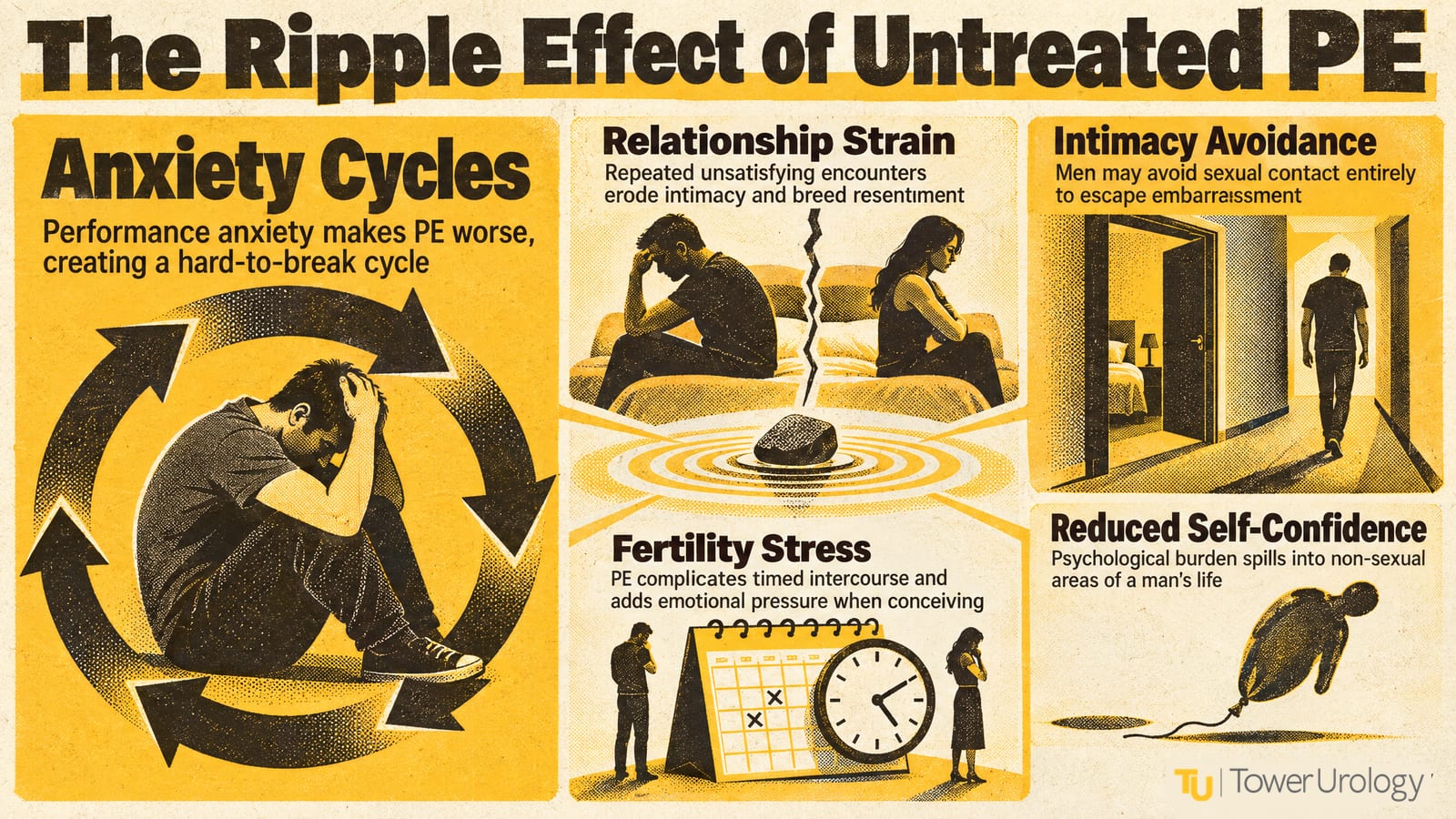
Relationship strain. Repeated unsatisfying sexual encounters can erode intimacy, create resentment, and lead partners to feel disconnected or unwanted.
Anxiety cycles. The anticipation of PE can trigger performance anxiety that makes the problem worse, locking men into a cycle that is difficult to break without professional support.
Avoidance of intimacy. Some men begin avoiding sexual contact altogether to sidestep the embarrassment, which further damages relationships and self-esteem.
Fertility stress. In couples trying to conceive, PE can complicate timed intercourse and add significant emotional pressure to both partners.
Reduced self-confidence. The psychological burden of PE can affect a man’s confidence in non-sexual areas of life as well.
Recognizing these complications is not meant to alarm you – it is meant to validate that seeking treatment is a meaningful, worthwhile step.
How Is Premature Ejaculation Diagnosed?
Diagnosing PE begins with a sensitive, confidential, and comprehensive evaluation. At Tower Urology, your specialist may take any or all of the following steps:
Review your medical and sexual history, including symptom patterns, frequency, and IELT estimates
Conduct a physical examination to assess nerve sensitivity and signs of inflammation
Arrange hormone testing, if indicated, to evaluate testosterone and thyroid levels
Assess whether psychological and emotional factors are contributing
Screen for co-occurring conditions such as erectile dysfunction, prostatitis, or varicocele
An accurate diagnosis leads to a more targeted, successful treatment plan – and it starts with making sure PE is not being confused with something else.
Can Premature Ejaculation Be Misdiagnosed?
Yes. PE is sometimes confused with delayed ejaculation, erectile dysfunction, or reduced libido caused by low testosterone. For example, a man who rushes to ejaculate because he is anxious about losing his erection may appear to have PE when the primary problem is actually ED. Similarly, retrograde ejaculation – where semen travels backward into the bladder rather than forward – can be mistaken for PE in some presentations.
That is why a thorough evaluation by a trained men’s health specialist is essential. At Tower Urology, we take a thoughtful, systematic approach to ensure an accurate diagnosis and precisely targeted treatment.
Treatment Options for Premature Ejaculation
Effective treatment for PE almost always involves a combination of approaches tailored to the individual. At Tower Urology, we offer the full spectrum – from self-help behavioral techniques to advanced in-office procedures that most urology practices do not provide.
Behavioral Techniques and Self-Help Strategies
Behavioral therapy is often the first line of treatment, particularly for acquired PE with a strong psychological component. These techniques train the body to recognize and manage arousal before the point of no return:
The stop-start technique: Sexual stimulation is paused just before ejaculation feels inevitable, allowing arousal to subside before resuming. Practiced consistently, this builds ejaculatory control over time.
The squeeze technique: At the moment of impending ejaculation, gentle pressure is applied to the head of the penis for several seconds to reduce arousal. A partner can assist with this, making it a collaborative exercise.
Masturbation before sex: Ejaculating one to two hours before intercourse can reduce penile sensitivity and extend the time to ejaculation during partnered sex.
Distraction techniques: Mentally shifting focus away from sexual sensation can delay ejaculation, though this is generally considered a short-term strategy rather than a long-term solution.
Condom use: Condoms reduce penile sensitivity and can meaningfully extend IELT for men whose PE is driven by heightened sensitivity.
Pelvic floor therapy: Strengthening the pelvic floor muscles improves voluntary control over the ejaculatory reflex and can also address urinary incontinence.
Topical Anesthetics
Topical anesthetic creams and sprays containing lidocaine or a lidocaine-prilocaine combination are applied to the penis before intercourse to reduce penile sensitivity. They are used on-demand – meaning only when needed – and can significantly extend IELT. The key is applying them 10-20 minutes before sex and wiping off any excess to avoid transferring the anesthetic to a partner.
Oral Medications
Medications that modulate serotonin levels are the most evidence-based pharmacological treatment for PE:
SSRIs (daily use): Antidepressants such as paroxetine, sertraline, and fluoxetine raise serotonin levels and reliably delay ejaculation. They are taken daily and typically take one to two weeks to reach full effect.
Dapoxetine (on-demand use): Dapoxetine is a short-acting SSRI specifically designed for PE. It is taken one to three hours before sex and works within a single dose, making it a flexible option for men who prefer not to take a daily medication.
PDE5 inhibitors (Cialis, Viagra): For men who have both PE and erectile dysfunction, medications like tadalafil or sildenafil can address both conditions simultaneously by improving erection quality and reducing performance anxiety.
Tramadol: This mild opioid analgesic has demonstrated ejaculation-delaying effects and is sometimes used off-label when SSRIs are not tolerated, though it carries its own risk profile and is used selectively.
Advanced In-Office Treatments at Tower Urology
Tower Urology offers access to cutting-edge therapies that are not routinely available at general urology practices. These treatments are particularly valuable for men who have not responded adequately to behavioral techniques or medication.
Botulinum toxin (Botox) injections relax the bulbospongiosus muscle, which plays a central role in the ejaculatory reflex. By reducing the contractile force of this muscle, Botox extends the time to ejaculation without affecting sensation or orgasm quality. Importantly, this is not experimental: a published randomized controlled trial (Abdel-Hamid et al., 2024, PubMed) demonstrated that bulbospongiosus muscle Botox injection is both safe and effective for lifelong premature ejaculation, with significant IELT improvements compared to placebo. Recovery is minimal, with most men returning to normal activity within 24 to 48 hours.
Platelet-rich plasma (PRP) therapy, offered through Tower Urology’s P-Shot program, uses growth factors derived from your own blood to rejuvenate penile tissue, improve sensitivity regulation, and support vascular health. PRP has shown benefit for men experiencing both erectile dysfunction and premature ejaculation, and it is a natural, minimally invasive option with no systemic side effects.
Low-intensity shockwave therapy uses acoustic waves to stimulate blood vessel growth and improve penile blood flow. While primarily established for ED, improved vascular function and reduced performance anxiety can have a positive downstream effect on ejaculatory control.
If your PE overlaps with fertility concerns or other sexual health issues, our team collaborates with men’s health specialists across disciplines to offer complete, coordinated care – including penile implants and vasectomy reversal where relevant.
Sex Therapy and Psychological Support
For men whose PE has a significant psychological component – or where the condition has created anxiety, shame, or avoidance – working with a sex therapist or psychologist is a powerful complement to medical treatment. Cognitive behavioral therapy (CBT) helps men identify and reframe the thought patterns that fuel performance anxiety. Sex therapy provides structured exercises and communication tools that address PE at its psychological root.
Involving Your Partner in Treatment
PE is rarely just one person’s problem. It affects both partners, and involving a partner in treatment consistently improves outcomes. Open, honest communication about PE – what it feels like, what triggers it, and what both partners need – reduces the shame and pressure that often make the condition worse.
Partners can actively participate in behavioral techniques like the squeeze and stop-start methods, turning what might feel like a clinical exercise into a shared, collaborative experience. Couples therapy or sex therapy can provide a structured, supportive environment for these conversations, particularly when PE has already created distance or tension in the relationship. Research consistently shows that couples who address PE together report higher satisfaction with treatment outcomes than men who pursue treatment alone.
At Tower Urology, we encourage partners to join consultations when both parties are comfortable. Understanding the condition together often accelerates recovery.
Long-Term Prognosis: What Can You Realistically Expect?
The outlook for men with PE is genuinely positive. With appropriate treatment, the majority of men experience significant improvement in ejaculatory control, sexual satisfaction, and relationship quality. The key word is “appropriate” – the right treatment for your specific subtype and underlying cause makes an enormous difference.
For lifelong PE, long-term management with daily SSRIs or periodic Botox injections may be needed to maintain improvement, much like managing any chronic condition. Many men find that after a period of behavioral therapy, they develop enough control to reduce or discontinue medication. For acquired PE, resolving the underlying trigger – whether that is treating prostatitis, correcting a hormone imbalance, or addressing relationship stress – often leads to complete resolution.
In most cases, PE does not signal a serious underlying disease. However, because it can occasionally be the first sign of a condition like prostatitis, low testosterone, or thyroid dysfunction, a proper evaluation is always worthwhile. If you have noticed a sudden change in ejaculatory control after a period of normal function, that is a particularly good reason to see a specialist promptly.
Most men who commit to a treatment plan – whether behavioral, pharmacological, or procedural – see meaningful improvement within four to twelve weeks. Some notice changes within days of starting medication. Progress is real and achievable.
Prevention and Lifestyle Habits That Reduce Recurrence
While PE cannot always be prevented, particularly in its lifelong form, several lifestyle habits can meaningfully reduce the risk of recurrence and support long-term ejaculatory health:
Manage stress proactively. Chronic stress elevates cortisol and disrupts the neurotransmitter balance that regulates ejaculation. Regular exercise, adequate sleep, and mindfulness practices all help.
Limit alcohol. While alcohol may temporarily reduce anxiety, it disrupts the neurological pathways involved in sexual function and can worsen PE over time.
Maintain pelvic floor health. Regular pelvic floor exercises (Kegels) strengthen the muscles involved in ejaculatory control and are one of the few self-directed interventions with strong evidence.
Address underlying health conditions. Keeping conditions like prostatitis, low testosterone, and thyroid dysfunction well-managed reduces their contribution to PE.
Communicate openly with your partner. Relationship tension and unspoken sexual dissatisfaction are among the most common triggers for acquired PE. Regular, honest communication is genuinely protective.
Continue behavioral practice. The ejaculatory control built through stop-start and squeeze techniques can diminish if not maintained. Periodic practice, even after symptoms resolve, helps preserve gains.
Why Choose Tower Urology for Premature Ejaculation Treatment in Los Angeles?
Premature ejaculation is common, but it is also highly treatable – and seeking care is a meaningful step toward improving your sexual well-being, your confidence, and your relationships. At Tower Urology, our board-certified urologists provide compassionate, confidential care tailored to your unique situation. We deliver unparalleled expertise and a genuinely safe space to address your sexual health, without judgment.
Tower Urology is a proud affiliate of Cedars-Sinai Medical Center, ranked #1 in California and #2 nationwide by U.S. News and World Report. This partnership reflects our commitment to delivering the highest standard of urologic care alongside the best urologists in Los Angeles. Our access to Cedars-Sinai’s world-class facilities ensures that our care is not only compassionate but exceptional.
We treat a wide range of men’s health conditions, including erectile dysfunction, low testosterone, chronic pelvic and testicular pain, prostatitis, vasectomy and vasectomy reversal, penile implants, shockwave therapy, male infertility, enlarged prostate, urinary incontinence, Peyronie’s disease, and support for men undergoing or recovering from prostate cancer treatment.
Tower Urology is conveniently located for patients throughout Southern California and the Los Angeles area, including Beverly Hills, Santa Monica, West Los Angeles, West Hollywood, Culver City, Hollywood, Venice, Marina del Rey, Burbank, Glendale, and Downtown Los Angeles.
Premature ejaculation frequently asked questions

Learning how to prevent premature ejaculation often involves a combination of approaches, including behavioral techniques, pelvic floor exercises, and sometimes medical treatment. In many cases, reducing stress, improving communication with a partner, and avoiding overstimulation can also help.
The treatment of premature ejaculation is highly personalized based on each man’s medical history, symptoms, and goals. Options range from SSRIs, topical sprays, and pelvic floor therapy to PRP, Botox injections, and shockwave therapy. Your provider will help determine what’s best for you.
If you’re looking for a trusted men’s health urologist in Los Angeles or Southern California, Tower Urology offers expert care, discreet support, and the latest diagnostic and treatment tools for PE and related sexual health concerns.
Yes, ejaculation typically includes sperm, even if it happens prematurely. However, fertility may be impacted if there are additional issues, such as a low sperm count or blocked sperm ducts.
No. PE is one of the most treatable sexual dysfunctions in men. The vast majority of men who pursue treatment – whether behavioral, pharmacological, or procedural – experience significant improvement. Even lifelong PE, which has a stronger neurobiological basis, responds well to SSRIs and advanced treatments like Botox. “Permanent” is rarely the right word for a condition this responsive to modern urology.
Untreated PE can place real strain on a relationship, particularly when it leads to avoidance of intimacy, unspoken frustration, or a partner feeling disconnected. However, couples who address PE together – through open communication, partner-assisted behavioral therapy, or couples counseling – typically report that working through the condition actually strengthens their relationship. The problem is less PE itself than the silence around it.
It depends on the treatment. On-demand medications like dapoxetine or topical lidocaine can work within a single use. Daily SSRIs typically take one to two weeks to reach full effect. Behavioral techniques require consistent practice over several weeks before control improves noticeably. Botox injections generally show results within two to four weeks as the muscle relaxes. PRP therapy may take four to six weeks for tissue-level changes to manifest. Your Tower Urology specialist will give you a realistic timeline based on your specific treatment plan.
In most cases, no. PE is often a standalone condition with psychological or neurobiological roots. However, because it can occasionally signal an underlying issue – such as prostatitis, low testosterone, or thyroid dysfunction – a proper evaluation is always a good idea, especially if PE has developed suddenly after a period of normal function.
Self-help techniques like the stop-start method, squeeze technique, and pelvic floor exercises can help, particularly for mild or situational PE. Over-the-counter topical anesthetics are also available without a prescription. That said, a specialist evaluation helps identify whether an underlying condition is contributing, and prescription treatments like dapoxetine or SSRIs are significantly more effective than self-help alone for moderate to severe PE.
Yes, the two conditions frequently co-occur. Some men rush to ejaculate because they are anxious about losing their erection, which can look like PE when the primary issue is actually ED. Treating the ED often resolves the apparent PE. At Tower Urology, we screen for both conditions at every evaluation to ensure we don’t miss anything.
-
Premature ejaculation – current concepts in the management: A narrative review
https://pmc.ncbi.nlm.nih.gov/articles/PMC7851481 -
Premature Ejaculation
https://www.ncbi.nlm.nih.gov/books/NBK546701 -
Erectile Dysfunction
https://www.ncbi.nlm.nih.gov/books/NBK562253 -
Is bulbospongiosus muscle Botox injection safe and effective in treating lifelong premature ejaculation? Randomized controlled study
https://pubmed.ncbi.nlm.nih.gov/38581447/