What is hCG?
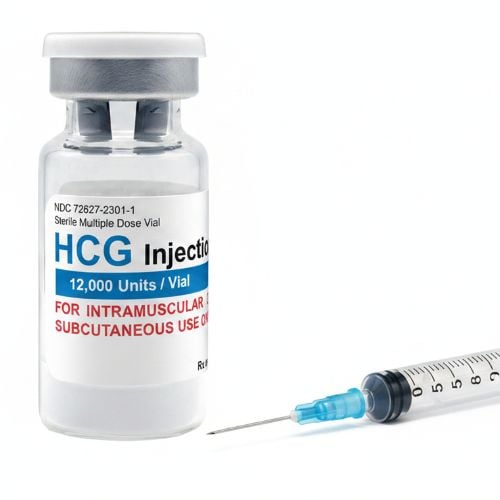
hCG stands for human chorionic gonadotropin. You may see it sold under the brand name Pregnyl. It’s the same hormone that rises sharply in early pregnancy, and it’s exactly what an at-home pregnancy test is looking for.
So why would our Tower Urology professionals prescribe it to men? Because hCG has a job in the male body that has nothing to do with pregnancy.

How hCG raises testosterone
The male body makes testosterone through a chain of command. The brain sends out a chemical messenger called luteinizing hormone (LH). When LH reaches the Leydig cells inside the testicles (testes), those cells convert cholesterol into testosterone.
Here’s the useful part: at the molecular level, hCG is a near-perfect copy of LH. The Leydig cells can’t tell the two apart. When hCG docks onto the same receptor LH would normally use, those cells get to work producing testosterone just as they would with the real thing.
The key difference is where the signal starts. hCG skips the brain entirely. It doesn’t work through the hypothalamus or the pituitary gland; it goes straight to the testicles and delivers the message directly.
hCG also sends a stronger, longer-lasting signal than your own LH does, so even a small dose can reduce testosterone deficiency (produce a meaningful rise in testosterone).
How hCG differs from Clomid and Enclomiphene
The full system is called the hypothalamic-pituitary-gonadal (HPG) axis. Think of it as a three-level chain: your hypothalamus at the top, your pituitary in the middle, and your testicles at the bottom.
Clomid (clomiphene citrate) and enclomiphene work at the top of that chain. They block estrogen receptors in the hypothalamus, which essentially tricks your brain into thinking estrogen is running low. Your brain responds by increasing a signal called gonadotropin-releasing hormone (GnRH), which pushes your pituitary to release more LH and follicle-stimulating hormone (FSH), which then stimulate your testicles.
hCG works at the opposite end, at the testicle itself. One tradeoff worth knowing: because it bypasses the brain, hCG does not raise FSH, the hormone most closely tied to sperm production (spermatogenesis).
Who hCG works for, and who it won’t help
This is the single most important thing to understand about hCG. All it does is deliver a message, so something has to be there to receive it. If your testicles can still do the job, hCG can work beautifully. If they cannot, no amount of signal will change that.
When the signal is the problem
Some men have low testosterone levels because the message from the brain is weak. When we look at your blood test in the lab, we see low testosterone alongside LH and FSH that are low or in the low-normal range. Doctors call this secondary hypogonadism, which simply means the testicles are fine, and the instructions never arrived.
These are the men hCG was made for. The only thing missing is the signal, and hCG supplies it directly.
When the testicles are the problem
Other men have low testosterone due to poor testicular function (the testicles themselves aren’t working correctly). When we look at your blood test in the lab, we see low testosterone with LH and FSH that are high, because the brain is shouting, but nothing is answering. This is called primary hypogonadism. It can be the result of Klinefelter syndrome, chemotherapy, radiation, or testicular atrophy (significant testicular shrinkage).
Here, hCG will not work. The signal is there, but the testicles are not producing.
This is exactly why our Tower Urologogy urologists look at your LH and FSH, and not just your total testosterone, before recommending anything.
What the research shows
In a 2019 study of 20 men treated with hCG alone, average testosterone climbed from roughly 362 ng/dL to roughly 520 ng/dL, about a 50% increase, over a median of eight months. Half the men said their symptoms improved, and no side effects or complications were reported.
A 2022 study of 31 men on weekly hCG monotherapy found that 80% reported better libido and 86% reported improved erectile function. Their bloodwork held steady, with no meaningful shifts in hematocrit (a measure of how thick your blood is), PSA, estrogen, or blood sugar, and no blood clots.
Research on men switched from TRT to hCG alone points in the same direction: most reported their symptoms improved, hematocrit dipped slightly, and no clotting events occurred. That last detail matters, because thickened blood is one of the more common headaches with TRT.
These are small studies, so it is fair to read the numbers as encouraging rather than settled.
What if your testosterone is “normal” but you still feel awful?
Treatment guidelines and insurance plans generally draw the line for TRT at 300 ng/dL. Plenty of men land above that number and still feel terrible: no energy, no libido, muscle slipping away, foggy thinking. On paper they do not qualify. In real life they are miserable.
Both studies above were done in exactly this group, men with symptoms and testosterone above 300 ng/dL. Weekly hCG improved how they felt without disturbing hematocrit, PSA, or blood sugar. That makes it a genuinely useful middle path when our doctors want to help you feel better without committing you to lifelong testosterone.
Using hCG alongside testosterone replacement therapy

One of the most common uses of hCG therapy isn’t as a standalone treatment at all. It’s as a companion to TRT.
When you start exogenous testosterone, your brain reads the high level in your blood and shuts its own signal down. LH and FSH fall to nearly zero within weeks. Starved of stimulation due to testosterone-induced gonadotropin suppression, your testicles stop making testosterone internally, lose volume, and sharply cut back sperm production (leading to a low sperm count).
Adding low-dose hCG alongside TRT or other forms of hormone replacement therapy, commonly 250 to 500 IU two or three times a week, keeps that receptor switched on. It maintains intratesticular testosterone inside the testicle, preserves testicular size, and protects at least some sperm production. If you’re not certain whether you want children down the road, that’s a sensible hedge.
hCG’s side effects and practical drawbacks
Estrogen
Testosterone naturally converts into estradiol, a form of estrogen. Because hCG ramps up testosterone production inside the testicle, it can raise estrogen along with it. How much estrogen depends heavily on your dose. At the low doses used alongside TRT, the change is usually small and causes no trouble. At the higher doses used for fertility treatment, some men notice nipple tenderness (gynecomastia), fluid retention, or mood changes. Our doctors may add a medication called an aromatase inhibitor to balance things out.
Injections, cost, and supply
hCG is an injectable. It arrives as a freeze-dried powder you mix with liquid and inject under the skin, usually two or three times a week. Other treatments, such as enclomiphene and clomiphene are pills, so that’s a real difference in daily life. Many men find the routine of hcg injections easy. For others it’s a dealbreaker, and that’s worth saying out loud at your visit.
hCG also costs more than clomiphene or enclomiphene, and insurance does not always cover it for low testosterone or fertility preservation in men. Compounding pharmacies used to help fill that gap, but a 2020 FDA rule change reclassified hCG as a biologic, which removed it from the compounding exemptions and tightened supply.
How do Tower Urology professionals choose the right option for you?
Matching the right treatment to the right patient is the whole job, and it starts with a proper workup rather than a prescription pad. Our urologists at Tower Urology will look at your full hormone picture, talk through your fertility plans, and walk you through the tradeoffs of each option in plain language.
If you have been dealing with fatigue, low libido, infertility issues or other symptoms of low testosterone, contact Tower Urology today to schedule a consultation.
Talk with Tower Urology’s Los Angeles urologists about your testosterone
Our Tower Urology professionals treat low testosterone, often referred to as low t, erectile dysfunction, low libido, and male fertility concerns as connected problems, because they usually are. Browse our full range of men’s sexual health services or meet our urologists.
Call us or request your appointment online: (855) 246-2700 or request your appointment online.