You have been diagnosed with benign prostatic hyperplasia (BPH). Your urologist has just handed you a set of options (UroLift, Rezum, TURP, PAE, and Aquablation) and told you to think them over.
So, now you’re home, staring at websites full of conflicting information, wondering which procedure or lifestyle changes actually fit your prostate, your lifestyle, and your priorities.
That feeling is completely understandable, especially if natural remedies or supplements haven’t provided enough relief. BPH affects millions of men, causing lower urinary tract symptoms, and the treatment landscape has expanded dramatically over the past decade.
More procedures, ranging from minimally invasive options to more involved surgery, mean more decisions. More decisions mean more anxiety when the stakes are things like urinary function, sexual health, and your quality of life.
Most men are actively choosing between UroLift, TURP, and Aquablation. This guide compares these three procedures in clinical depth, and also explains where two other important options, Rezum and PAE, fit into the picture.
You’ll learn how each procedure works, which prostate sizes and anatomies qualify for each, what the clinical evidence says about sexual function preservation, and what recovery actually looks like. Most importantly, you’ll leave with a clear framework, so you can walk into your next consultation prepared to make the right choice for your body and your life.
Why choosing between these procedures is more personal than you think
Most online comparisons treat choosing a procedure as a purely clinical question. In other words, which procedure has the best symptom scores? But at Tower Urology, our experience confirms that the right procedure is rarely the one with the highest average outcome on a population chart. Rather, it’s the one that aligns with what you personally cannot afford to compromise on.
A 52-year-old man who is sexually active and worried about retrograde ejaculation from surgery or the daily use of tamsulosin (a medication that treats the symptoms of an enlarged prostate) has completely different priorities than a 74-year-old man whose primary goal is durable, long-term relief with minimal retreatment risk. Both have BPH. Both may have similar International Prostate Symptom Scores (IPSS). But given their personal situations and priorities, the right procedure for each of them is almost certainly different.
The choice of procedure should also be based on more than just symptom relief. It should consider whether you are anatomically eligible, what anesthesia is required, how long recovery takes, and what happens if the first procedure doesn’t deliver lasting results. Understanding these differences before your consultation means you can have a real conversation with your urologist rather than simply accepting a recommendation without context.
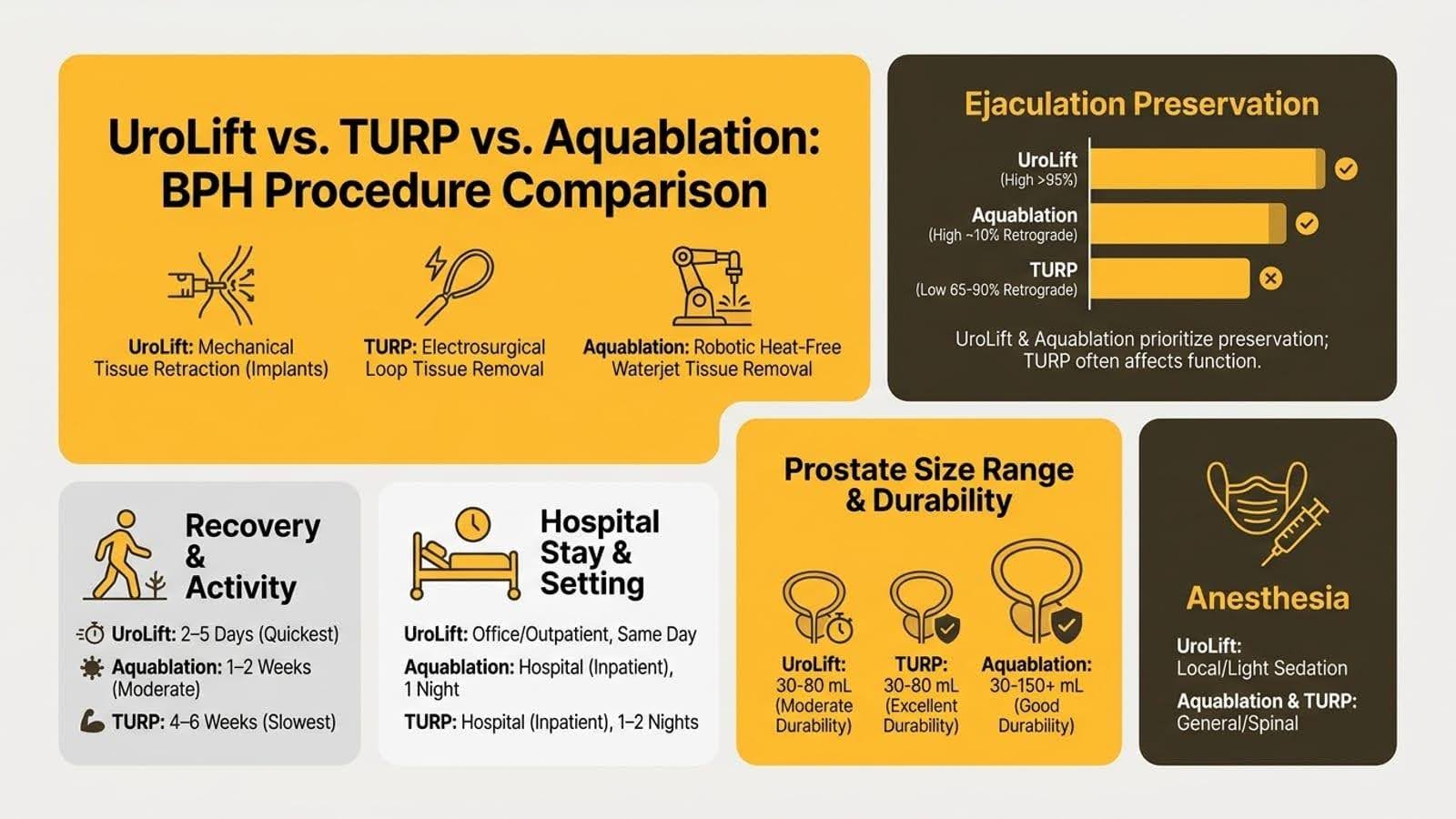
How each procedure works: UroLift, TURP, and Aquablation side by side
UroLift
UroLift is a prostatic urethral lift procedure developed by NeoTract (now part of Teleflex). It received FDA clearance in 2013. This procedure does not remove or destroy prostate tissue. Instead, small permanent implants are placed through the urethra to pull the enlarged lateral lobes of the prostate away from the urethral channel, mechanically opening the passage. The procedure typically takes 30 to 60 minutes and can be performed under local or light sedation in an office or outpatient setting.
A related office-based option is Rezum. It is often weighed against UroLift, so it is worth understanding here. Rezum uses targeted water vapor (steam) to shrink excess prostate tissue, relieving pressure on the urethra and improving urine flow. It is best suited to prostates under about 80 mL, a similar size range to UroLift, and it is not recommended for men with an artificial urinary sphincter or an inflatable penile prosthesis. Like UroLift, it takes roughly 20 to 30 minutes, is performed under local or light sedation, and is done in the office or an outpatient setting. Return to work and activity is also similar to UroLift
The important differences between these two in-office procedures is clinical:
- Rezum can treat a median lobe. UroLift cannot.
- Rezum can cause retrograde ejaculation. UroLift does not.
Office-based options at a glance: UroLift vs Rezum
| Feature | UroLift | Rezum |
|---|---|---|
| How it works | Implants hold the lobes open, no tissue removed | Steam shrinks excess tissue over weeks |
| Median lobe | Cannot treat | Can treat |
| Ejaculation | Usually preserved | Can cause retrograde ejaculation |
| Prostate size | Up to about 80 mL | Up to about 80 mL |
Transurethral resection of the prostate (TURP)
TURP has been the gold standard for BPH surgery for over 70 years. In this procedure, a surgeon inserts a resectoscope through the urethra and uses a heated electrosurgical wire loop to cut away obstructing prostate tissue in small chips. It requires spinal or general anesthesia and typically involves a short hospital stay. The tissue removal is direct and substantial, which is why TURP has historically delivered the most durable symptom relief. Most TURP procedures today use bipolar energy, which has meaningfully lower complication rates than the historical monopolar technique.
Aquablation
Aquablation, delivered via the AQUABEAM Robotic System developed by PROCEPT BioRobotics, uses a high-velocity, heat-free waterjet guided by real-time ultrasound imaging and robotic precision to remove prostate tissue. Unlike TURP, the resection plan is mapped before the procedure begins, and the robotic system executes it without the surgeon manually steering the loop. This reduces variability from surgeon experience and allows more precise tissue removal, particularly in larger or irregularly shaped prostates. It requires spinal or general anesthesia and typically involves a short hospital stay.
The three procedures at a glance
| Feature | UroLift | TURP | Aquablation |
|---|---|---|---|
| Mechanism | Mechanical implants retract tissue | Electrosurgical loop removes tissue | Robotic, heat-free waterjet removes tissue |
| Anesthesia | Local or light sedation | Spinal or general | General or spinal |
| Setting | Office or outpatient (ASC) | Hospital, or outpatient ASC for smaller glands | Hospital (inpatient) |
| Hospital stay | None | None or 1 night, rarely 2 | 1 night |
| Prostate size range | 30-80 mL (no median lobe) | 30-80 mL (standard) | 30-150+ mL |
| Ejaculation preservation | High (>95%) | Low (65-90% retrograde) | High (WATER trial: ~10% retrograde) |
| Return to normal activity | 2-5 days | 1-2 weeks | 1-2 weeks |
| Long-term durability | Moderate (higher retreatment rate) | Excellent (<10% retreatment at 10 years) | Good and evolving (comparable to TURP in 5-year trials) |
Prostate size and anatomy: which procedure are you actually eligible for?
This is the question most online comparisons skip entirely, and it often determines your options before personal preference even enters the picture.
Who is not a good candidate for UroLift after medications like dutasteride fail?
UroLift has a specific anatomical limitation that disqualifies a meaningful portion of BPH patients: it cannot effectively treat median lobe hyperplasia. The median lobe is a third lobe of the prostate that can grow upward into the bladder neck. UroLift implants are designed to retract only the lateral lobes. If your prostate has significant median lobe involvement, UroLift will not adequately open the urethral channel.
Men with prostates larger than 80 mL are also generally outside the optimal range for UroLift, as the implants may not retract enough.
Men with active urinary tract infections, or those who have not tried and failed medical therapy with medications such as alpha-blockers like alfuzosin or 5-alpha reductase inhibitors like finasteride, may also be directed toward other options first, per American Urological Association BPH clinical guidelines.
Can Aquablation be used for any prostate size?
Aquablation’s robotic, ultrasound-guided approach gives it a significant size advantage. The WATER II randomized controlled trial, published on PubMed, specifically evaluated Aquablation in prostates ranging from 80 to 150 mL. This trial demonstrated safety and efficacy in that large-prostate population, where TURP becomes technically challenging and UroLift is not indicated.
What about prostate size and TURP?
TURP remains size-flexible in the 30 to 80 mL range, but becomes technically more demanding and carries higher bleeding risk as prostate volume increases.
Other options for large prostates
For prostates above 80 mL, besides Aquablation, many urologists suggest HoLEP (holmium laser enucleation of the prostate). For very large prostates (above 120 mL), robotic simple prostatectomy is still typically the preferred approach.
What if none of the above fit? Enter Prostate Artery Embolization (PAE)
Some men are not good candidates for any of the procedures above. Men on blood thinners, those with significant cardiovascular comorbidities that make anesthesia risky, or those with anatomical features that complicate transurethral access may find that neither UroLift, Rezum, TURP, nor Aquablation is appropriate for them. Their option is prostate artery embolization (PAE).
PAE is a minimally invasive, non-surgical alternative performed by an interventional radiologist rather than a urologist. Small particles are injected through a catheter, usually via the wrist or groin, to block the blood supply to the prostate, causing it to shrink over several weeks. The procedure is done in an outpatient setting, similar to a heart angiogram, and does not require general anesthesia.
PAE has some distinct advantages: minimal downtime, minimal urinary symptoms, no need for a catheter, and no meaningful impact on ejaculation or erections. It generally requires a gland of around 40 g or larger to be effective. Because it works gradually, it is not ideal for men who are in urinary retention or who need rapid symptom relief, and it does not work in every patient, particularly those with calcified vessels or accessory arteries feeding the prostate.
PAE is not a replacement for surgery in men who are good surgical candidates. Its symptom relief is generally less dramatic than TURP or Aquablation, and its durability data are still accumulating. But for the right patient, it represents a genuinely valuable option that should be part of the conversation. Explore our comprehensive prostate and BPH treatment options at Tower Urology to learn how we evaluate each patient’s candidacy across the full range of available treatments.
Sexual function and ejaculation: what the clinical evidence really shows
For many men, this section matters most.
Erectile function
Erectile function outcomes are broadly similar across all of these procedures, with none of them carrying a high direct risk of erectile dysfunction (ED) when performed correctly. The greater ED risk in BPH surgery generally comes from nerve damage during more extensive procedures, which is less of a concern with these transurethral approaches. PAE has no meaningful impact on erections.
Retrograde ejaculation
Retrograde ejaculation, where semen travels backward into the bladder during orgasm rather than forward, is one of the most common and distressing side effects of BPH surgery. It does not affect the sensation of orgasm, but it does affect fertility and can be psychologically significant for men who were not prepared for it.
Of all the procedures, PAE has no meaningful impact on ejaculation.
Does UroLift preserve ejaculatory function better than TURP?
Yes, and by a substantial margin. Because UroLift does not remove or thermally damage prostate tissue, the ejaculatory ducts and surrounding structures remain intact. Clinical trial data consistently show retrograde ejaculation rates below 5% for UroLift, compared to 65 to 90% for TURP depending on the technique used. (Among the office-based options, this is the key contrast with Rezum, which can cause retrograde ejaculation.)
An indirect 2021 comparison study found that UroLift patients maintained higher sexual function domain scores compared to TURP patients.
What about Aquablation and preserved ejaculation?
In the same 2021 comparison study, the difference between UroLift and Aquablation was not statistically significant.
However, Aquablation’s ejaculation preservation rates are notably better than TURP’s. The WATER randomized controlled trial from above reported retrograde ejaculation in approximately 10% of Aquablation patients versus 36% of TURP patients. For men who prioritize sexual function but have a prostate anatomy that disqualifies them from UroLift, Aquablation represents a meaningful middle ground: tissue removal with substantially lower ejaculatory risk than TURP.
How long does recovery take after UroLift vs. TURP vs. Aquablation?
Recovery differences between these procedures are dramatic, and they matter enormously for men who cannot afford extended time away from work or family responsibilities.
UroLift
After UroLift, most men experience some urinary urgency, frequency, and mild discomfort for the first one to two weeks. A catheter is usually placed overnight. Most men return to desk work within two to five days and resume physical activity within one to two weeks. There is no tissue removal, so there is no healing wound inside the prostate. (Rezum recovery is broadly similar, with irritative urinary symptoms that can last four to six weeks.)
TURP
After TURP, a urinary catheter is typically in place for one to three days, and most men stay in the hospital one night, rarely two. Urinary symptoms including urgency, frequency, and occasional blood in the urine can persist for several weeks while the resection site heals. Most men are advised to avoid strenuous activity for 1-2 weeks, with return to full normal activity, including sexual activity, typically around 3 weeks post-procedure.
Aquablation
Aquablation recovery sits between the two. A catheter is generally in place for 1 to 2 days, and the hospital stay is typically 1 night. Most men experience urinary symptoms for two to four weeks and return to normal activity within one to two weeks for light tasks, with fuller recovery closer to four weeks. The absence of thermal energy in Aquablation means less surrounding tissue irritation than TURP, which many patients report as a noticeably smoother recovery.
Long-term durability and retreatment rates: how long do results last?
Durability is where these procedures diverge most sharply, and younger men in particular need to weigh it carefully.
TURP has the longest track record. At 10 years, retreatment rates are below 10%, making it the benchmark against which all newer procedures are measured. The tissue removal is substantial and permanent, which is why symptom relief tends to be both significant and lasting.
Aquablation’s durability data is still maturing given its more recent adoption, but the WATER trial results at five years show retreatment rates comparable to TURP, a strong signal for a procedure that has only been widely available since the late 2010s. For men with larger prostates who previously had limited minimally invasive options, this is a meaningful development.
Rezum’s durability sits in the middle: generally, more durable than UroLift, but less durable than Aquablation or TURP.
UroLift’s durability is the most debated. UroLift is not a cure for BPH, and benign prostatic enlargement will continue to progress after the procedure. The implants remain in place permanently, but as the prostate enlarges further over time, symptoms can return. Five-year data show that a meaningful proportion of patients, with estimates ranging from 13 to 20%, require retreatment or additional intervention.
This does not mean UroLift is a poor choice. For men with mild to moderate BPH who want to preserve sexual function and avoid a hospital stay, UroLift can provide meaningful relief for five or more years. For them, the trade-off of a faster, less invasive procedure with lower sexual side effects is entirely worth a potentially higher retreatment rate.
But it does mean that a 45-year-old man choosing UroLift should understand he may need another procedure in his 50s or 60s.
For men seeking the most durable single intervention, TURP or Aquablation are more appropriate choices.
What happens if UroLift or Aquablation fails: can you still have TURP?
Yes, in most cases, and depending on the sequence of procedures you have had so far. In general, choosing a less invasive first procedure doesn’t close the door to more definitive treatment later.
One underappreciated advantage of UroLift is that it does not burn or remove tissue, so prostate anatomy is largely preserved if retreatment is needed. Men who have had UroLift can typically proceed to another treatment option if symptoms return or the initial result is insufficient.
Aquablation patients who require retreatment can also generally undergo TURP or repeat Aquablation, though the anatomy is more altered than after UroLift.
Because TURP removes substantial tissue, it’s typically the endpoint procedure rather than a stepping stone: retreatment after TURP usually involves repeat TURP or laser enucleation for regrowth.
How to choose: a decision framework based on your personal priorities
At Tower Urology, we’ve found that most men can clarify their decision by honestly answering four questions before their consultation.
1. How important is preserving ejaculation to you? If this is a top priority, UroLift, PAE, or Aquablation are the stronger options. If you are post-reproductive and this is not a concern, TURP’s superior durability may outweigh its ejaculatory side effects.
2. What is your prostate size and anatomy? Your urologist will assess this via ultrasound or MRI. If you have median lobe hyperplasia or a prostate above 80 mL, UroLift is likely off the table. If your prostate is above 100 mL, Aquablation, HoLEP, PAE, and simple prostatectomy are the most appropriate options.
3. How much recovery time can you realistically take? If you cannot be away from work or physical activity for more than a week, an office-based option like UroLift is the most accommodating. If you can take more time, TURP’s durability advantage becomes more attractive.
4. Are you optimizing for the next five years or the next twenty? Younger men with decades of prostate growth ahead of them may be better served by a more durable tissue-removing procedure. Older men, or those with significant comorbidities, may benefit more from UroLift’s lower procedural burden.
Robert, a Tower Urology patient, spent years dealing with constant urinary urgency that robbed him of restful nights and the freedom to travel. After exploring his options, he chose Prostate Artery Embolization (PAE), a different minimally invasive approach, and found relief that transformed his daily life. His story, detailed in our account of how PAE Restores Robert’s Quality of Life, reminds us that the best procedure is the one matched to the individual, not the one with the best average trial result.
Why choose Tower Urology for your BPH treatment

If you’re ready to talk with a specialist who can evaluate your anatomy, symptom severity, and personal priorities, we invite you to connect with our team. Our urologists at Tower Urology bring deep expertise and a team-based approach to BPH care, ensuring that the recommendation you receive is genuinely personalized to you, not a one-size-fits-all protocol.
Tower Urology’s board-certified urology team has led BPH care for over two decades, with specialists trained in all aspects of prostate health. We take the time to understand you so that we can personalize your treatment plan to your specific needs.
Tower Urology is a proud affiliate of Cedars-Sinai Medical Center, ranked #1 in California and #2 in the nation by U.S. News & World Report. This partnership reflects our commitment to delivering the highest standard of urologic care. Our years of experience and access to Cedars-Sinai’s world-class facilities make Tower Urology a leader in Southern California.
We invite you to establish care with Tower Urology.
Frequently asked questions about choosing between UroLift, TURP and Aquablation

TURP carries a higher rate of retrograde ejaculation (65 to 90%) than UroLift or Aquablation, its most cited drawback for sexually active men. It also requires general or spinal anesthesia, a short hospital stay, and a one to two-week recovery, with higher bleeding risk in larger prostates. Its complication profile is well understood after decades of use and remains safe in experienced hands, particularly with modern bipolar technique. Newer minimally invasive options cut specific risks like ejaculatory dysfunction and recovery burden but bring trade-offs around durability and eligibility.
-
An indirect comparison of newer minimally invasive treatments for benign prostatic hyperplasia: a network meta-analysis model. Tanneru K, Jazayeri SB, Alam MU, et al. J Endourol.
https://journals.sagepub.com/doi/10.1089/end.2020.0739 -
WATER: a double-blind, randomized, controlled trial of Aquablation vs transurethral resection of the prostate in benign prostatic hyperplasia. Gilling P, Barber N, Bidair M, et al. WJ Urol. 2018;199(5):1252-1261. doi:10.1016/j.juro.2017.12.065
https://www.auajournals.org/doi/10.1016/j.juro.2017.12.065 -
Five-year outcomes for Aquablation therapy compared to TURP: results from a double-blind, randomized trial in men with LUTS due to BPH. Gilling PJ, Barber N, Bidair M, et al. Can J Urol. 2022;29(1):10960-10968.
https://pubmed.ncbi.nlm.nih.gov/35150215/ -
Aquablation therapy in large prostates (80-150 mL) for lower urinary tract symptoms due to benign prostatic hyperplasia: final WATER II 5-year clinical trial results. Bhojani N, Bidair M, Kramolowsky E, et al. . J Urol.
https://www.auajournals.org/doi/10.1097/JU.0000000000003483 -
The prostatic urethral lift for the treatment of lower urinary tract symptoms associated with prostate enlargement due to benign prostatic hyperplasia: the L.I.F.T. study. Roehrborn CG, Gange SN, Shore ND, et al. J Urol.
https://pubmed.ncbi.nlm.nih.gov/23764081/ -
Treatment of LUTS secondary to BPH while preserving sexual function: randomized controlled study of the prostatic urethral lift. McVary KT, Gange SN, Shore ND, et al. . J Sex Med.
https://pubmed.ncbi.nlm.nih.gov/24119101/