For Robert, what started as minor urinary inconveniences gradually evolved into symptoms that significantly impacted his quality of life.
His journey began with managing his benign prostatic hyperplasia (BPH), commonly referred to as an enlarged prostate, with medication. It ended with his finding complete relief through an innovative minimally invasive procedure. This showcases how the right healthcare provider and cutting-edge treatment options can restore everyday living.
When gradual urinary changes became impossible to ignore
Like many men experiencing symptoms of BPH, Robert’s condition developed slowly over several years. “It’s kind of like losing hair or eyesight — it happens so gradually you adjust and begin to accept it as normal,” Robert reflects. “But you don’t really realize how much it’s affecting your life until you experience what actual normal feels like again.”
The signs were subtle at first. They included a weaker urine stream, more frequent trips to the bathroom, and an urgent need to urinate that seemed to come out of nowhere. These lower urinary tract symptoms (LUTS) are classic indicators of an enlarged prostate. In other words, the growing prostate gland puts pressure on the urethra, affecting the flow of urine from the bladder.
“I have been a patient of Dr. Josephson at Tower Urology for 17 or 18 years,” Robert explains. “And up until that point, I was taking Flomax and other alpha blocker medications, and it was okay.” Medications like tamsulosin (Flomax) and similar drugs are often the first line of treatment for mild symptoms of BPH. These medications help to relax the muscles around the bladder neck and prostate to improve urine flow.
But as time went on, Robert’s large prostate continued to grow, and the medication became less effective at managing his urinary problems. “Dr. Josephson told me, ‘You’re getting worse, and it’s time to do something else,'” Robert recalls.
An innovative alternative to traditional surgery
Traditional surgical treatments for severe BPH include procedures like transurethral resection of the prostate (TURP) or prostatectomy. However, these invasive procedures can carry risks, including erectile dysfunction, retrograde ejaculation, urinary incontinence, and other side effects that many men want to avoid.
When Dr. Josephson recommended prostate artery embolization (PAE), Robert was intrigued by this alternative approach. He was particularly impressed by Dr. Josephson’s commitment to staying at the forefront of urological innovations.
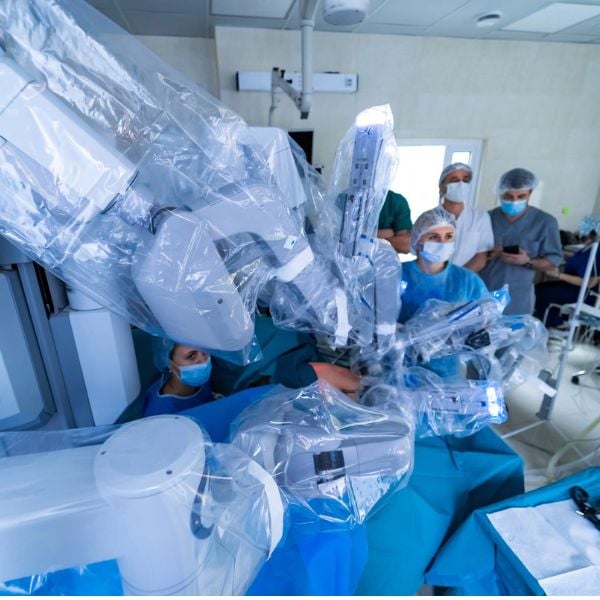
“I was told a long time ago that Dr. Josephson was kind of a pioneer of robotic surgery,” Robert recalls. “One day, I mentioned something about prostate cancer and minimally invasive robotic-assisted surgery, and he said, ‘I do those surgeries frequently, all through robotic assistance.’ I was amazed.”
This forward-thinking approach extends beyond just prostate cancer treatment to encompass the full spectrum of urological care. “He is very intelligent, forward-thinking,” Robert observes. “You feel excellent when you go to him, like the very latest treatments are made available to you.”
What is prostate artery embolization?
Prostate artery embolization (PAE) is a minimally invasive procedure that offers an alternative to traditional surgical treatments for men with benign prostatic hyperplasia. During the procedure, a specialist uses imaging guidance to insert a catheter through a small incision, typically in the groin or wrist. The catheter is then navigated to the arteries supplying blood to the prostate tissue.
Tiny particles are injected to block these blood vessels, thereby reducing blood flow to a specific part of the prostate. This causes the enlarged prostate to shrink over time, relieving symptoms like urinary retention, frequent urination, weak urine stream, and difficulty emptying the bladder.
The prostate artery embolization procedure is performed under local anesthesia. It typically takes 1-3 hours, and patients usually go home the same day or after an overnight stay.
The path to treatment for enlarged prostate (PAE)
Dr. Josephson explained that PAE was particularly effective for patients with significantly enlarged prostates. “He said it reduces the size of your prostate tremendously and cures a lot of these BPH problems,” Robert remembers. However, not every patient is a candidate for this procedure.
“There’s a lot of preliminary work,” Robert notes. “They do a CAT scan to check the blood vessels—they have to get a map of all the arteries to consider you a candidate for the procedure.” This comprehensive evaluation is crucial because the success of PAE depends on the anatomy of the blood vessels supplying the prostate gland.
The comprehensive approach involved reviewing Robert’s medical history, performing a physical exam, and conducting imaging scans. For some patients, this may also include additional tests, such as a digital rectal exam, a blood test for prostate-specific antigen (PSA), urine tests, and possibly a cystoscopy to assess the entire urinary tract.
Dr. Jospehson’s comprehensive healthcare approach ensures that patients receive the most appropriate treatment options for their specific situation.
“I saw a radiologist for a preliminary scan, and everything checked out. Then Dr. Josephson performed the procedure,” Robert explains, noting that he felt like he was in kind and capable hands the entire time.
Robert’s life-changing results thanks to prostate artery embolization
The results of Robert’s prostate artery embolization exceeded his expectations. “I like the results very much—it’s really been a huge difference,” he enthuses. “I can’t even remember when I last urinated this normally.”
The improvement in his lower urinary tract symptoms has had a profound impact on his daily life and overall well-being. “You take things for granted,” Robert reflects. “Now I can get on an airplane and don’t need the aisle seat or have to worry about urgently getting up in the middle of a flight. And I can sleep through the night without waking up.”
These improvements represent significant lifestyle changes that many men with BPH only dream of. The ability to sleep uninterrupted, travel comfortably, and not constantly worry about finding the nearest restroom represents a return to everyday living made possible by PAE.
The importance of long-term patient relationships
Robert’s story also highlights the value of establishing care with a trusted healthcare provider. “Dr. Josephson came to me years ago, highly recommended by my general practitioner,” Robert explains. “I went to this primary doctor for years, and whenever he recommended someone, they were always wonderful. He recommended Dr. Josephson as being an excellent urologist.”
Over nearly two decades of care, Robert developed deep trust in Dr. Josephson’s expertise. “Through the years, I came to trust his advice a lot,” he says. This long-term relationship allowed Dr. Josephson to monitor Robert’s condition over time, adjusting treatments as needed and recognizing when it was time to consider more advanced treatment options.
The Tower Urology difference
Robert’s experience at Tower Urology represents more than just successful treatment—it exemplifies comprehensive, coordinated care. “I’m delighted with Dr. Josephson and everyone who cared for me before, during, and after the procedure. I really like Tower; they are very thorough there,” he says.
Coming from a smaller healthcare environment, Robert was struck by the difference in quality and sophistication of care. “I told Dr. Josephson that I came from a small town in New Mexico. I didn’t realize it at the time, but there’s a big difference in the quality of care from that small town and the care I’m receiving here. It’s really not the same.”
His analogy perfectly captures his experience: “Dr. Josephson is wonderful, and it’s like the saying—you don’t know gourmet cooking until you’ve eaten it. Dr. Josephson and Tower Urology are just really ahead of the game.”
For other men struggling with prostate problems, Robert’s endorsement is wholehearted. “I would recommend it to other people,” he says of both the PAE procedure and Tower Urology’s care.
Understanding your options for BPH treatment
Robert’s story demonstrates that men with enlarged prostates have more treatment options than ever before. Some patients may benefit from lifestyle changes or medications, such as finasteride or dutasteride. Traditional procedures may help the situations of other men. Still others may be candidates for innovative approaches, such as PAE or prostatic urethral lift (UroLift).
The key is working with a urologist who takes a comprehensive approach to healthcare. Your medical professional should consider factors such as the size of your prostate, your risk factors, the severity of your symptoms, and your personal preferences regarding potential side effects.
For men experiencing urinary tract infections (UTIs), bladder stones, kidney damage, or severe urinary retention, prompt evaluation and treatment are essential. Even mild symptoms deserve attention, as BPH can progress over time and lead to complications if left untreated.
Robert’s journey from struggling with the daily challenges of BPH to enjoying normal urinary function illustrates the life-changing potential of expert urological care combined with cutting-edge treatment options.
Why choose Tower Urology for enlarged prostate care?
At Tower Urology, our specialists understand that complex cases like Robert’s require both advanced diagnostic skills and surgical expertise. Our team combines state-of-the-art robotic surgical techniques with a thorough investigative approach to ensure that no stone is left unturned in your urological care.
Our approach is personal—we treat patients, not just pathology.
Tower Urology is a proud affiliate of Cedars-Sinai Medical Center, ranked #1 in California and #2 nationwide by U.S. News & World Report. This partnership reflects our dedication to delivering the highest standard of urologic care alongside the best urologists in Los Angeles. Our years of experience and access to Cedars-Sinai’s world-class facilities ensure that our exceptional and innovative urological care positions Tower Urology as a leader in Southern California.
Tower Urology is conveniently located for patients throughout Southern California and Los Angeles, including Beverly Hills, Santa Monica, West Los Angeles, West Hollywood, Culver City, Hollywood, Venice, Marina del Rey, Burbank, Glendale, and Downtown Los Angeles.
Our services include BPH, elevated PSA and prostate artery embolization (PAE).
Frequently asked questions about prostate artery embolization and BPH

Weak urine flow, frequent urination (especially at night), difficulty initiating urination, dribbling at the end, and a feeling that the bladder doesn’t empty are common signs.
No. BPH and prostate cancer are separate conditions. However, both become more common with age. Regular checkups help monitor for cancer.
Alpha blockers (like tamsulosin) relax prostate and bladder muscles, while 5-alpha reductase inhibitors (like finasteride) shrink the prostate over time.
Yes. Obesity, excess caffeine or alcohol, and drinking fluids before bed can worsen symptoms. Weight management and lifestyle changes can sometimes help with mild symptoms of BPH.
Options include PAE, UroLift, Rezum (water vapor therapy), and certain laser procedures. Your doctor can help you determine the right one for you based on your anatomy and symptoms.
PAE usually preserves sexual function better than traditional surgery, but outcomes vary. Your doctor can explain the risks and benefits for your case.
Sources:
Benign Prostatic Hyperplasia
https://www.ncbi.nlm.nih.gov/books/NBK558920/
Prostate Artery Embolization (PAE) in the Treatment of Benign Prostatic Hyperplasia: A Case Series and Narrative Review
https://pubmed.ncbi.nlm.nih.gov/40507540/
Medical Advancements in Benign Prostatic Hyperplasia Treatments
https://pubmed.ncbi.nlm.nih.gov/38448685/