When your doctor says “you need to see a kidney specialist,” most Los Angeles patients don’t know whether to call a nephrologist, a urologist, or both – and that confusion can cost them months of critical treatment time. That delay matters, because kidney conditions rarely wait.

You’re not alone in feeling uncertain. The terms “kidney doctor” and “kidney specialist” get used interchangeably, but they describe two very different types of physicians with distinct training, tools, and treatment approaches. Getting to the right one first can mean the difference between a minimally invasive procedure and a much longer road to recovery.
This guide will give you three specific things: a clear explanation of what separates a nephrologist from a urologist, a practical symptom guide to help you decide which specialist fits your situation, and an honest look at how urological conditions silently damage kidney function before most patients ever receive a diagnosis. If you’re searching for a kidney doctor near you in Los Angeles, read this before you make that call.
Nephrologist vs. Urologist: Two Very Different Kidney Specialists
A nephrologist is an internal medicine physician who completed additional fellowship training in kidney disease. Their focus is medical management: slowing the progression of chronic kidney disease (CKD), controlling hypertension and diabetes that damage kidney tissue, managing electrolyte disorders, and overseeing dialysis or kidney transplant planning for patients with end-stage renal disease (ESRD). They do not perform surgery.
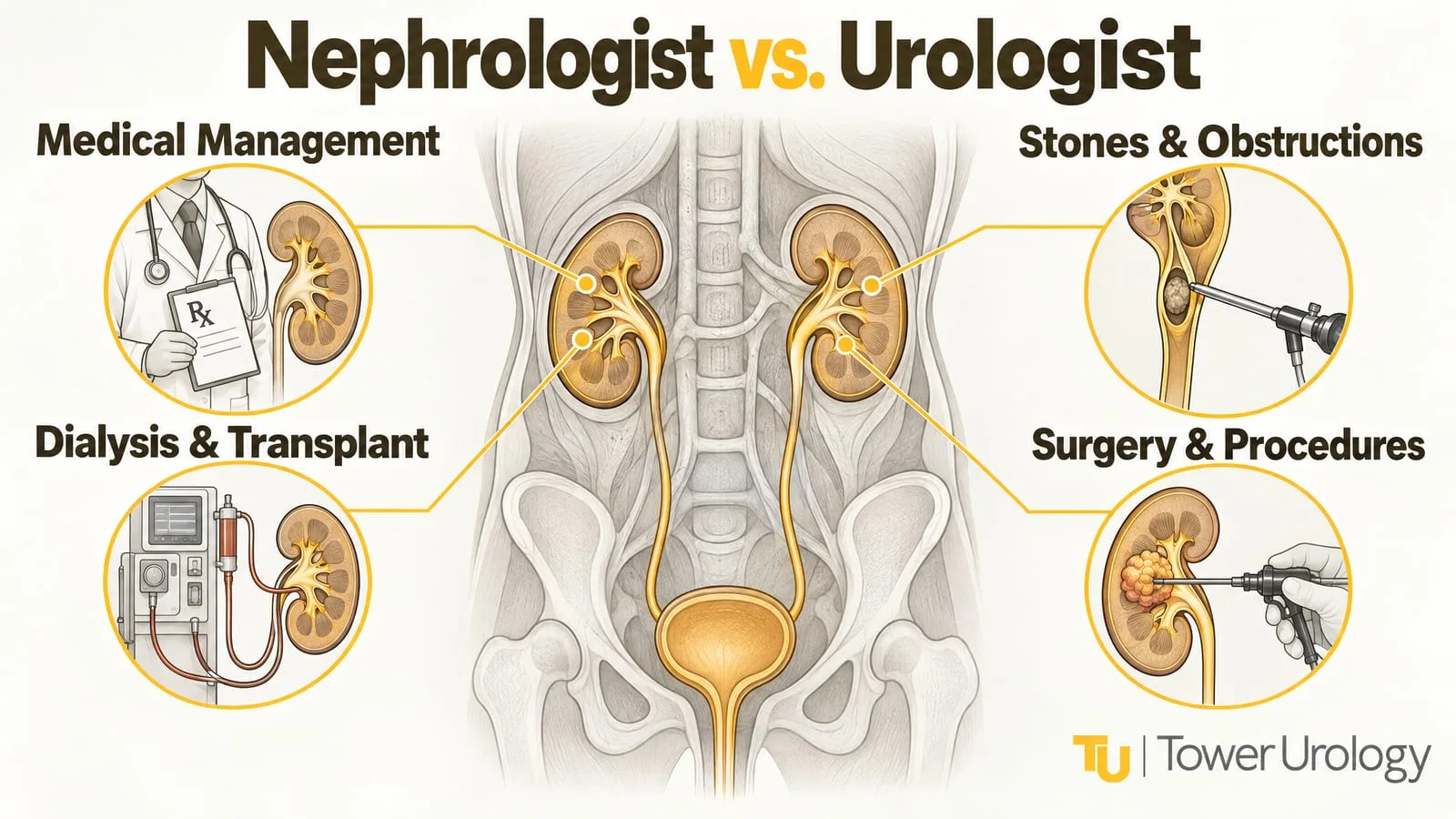
A urologist is a surgical specialist trained to treat conditions affecting the urinary tract and related structures, including the kidneys. Urologists handle kidney stones, kidney cancer, obstructive uropathy, recurrent urinary tract infections (UTIs), benign prostatic hyperplasia (BPH), and other conditions that physically block or damage the urinary system. When a problem requires a procedure, a scope, or surgery, a urologist is typically the right first call.
The confusion is understandable. Both specialists care for the kidneys. But their tools differ fundamentally: a nephrologist prescribes medications and manages disease progression, while a urologist intervenes surgically or procedurally to remove an obstruction, destroy a stone, or treat a tumor. Many patients need both at different stages of their care.
Does a urologist treat kidney disease?
Yes, but with an important distinction. Urologists treat kidney conditions that have a structural or surgical cause: kidney stones, kidney cancer, blockages caused by BPH or scar tissue, and infections that originate in the urinary tract. They do not manage chronic kidney disease as a systemic illness the way a nephrologist does. If your kidneys are failing due to diabetes or long-standing hypertension, that’s nephrology territory. If a stone blocks your ureter and threatens kidney function, that’s a urologist’s domain.
Which Kidney Conditions Belong to a Urologist?
Kidney stones are the most common reason Los Angeles patients visit a urologist. A stone lodged in the ureter can cause excruciating flank pain, blood in the urine, nausea, and, if left untreated, serious kidney damage. According to the National Institute of Diabetes and Digestive and Kidney Diseases, kidney stones affect roughly 11% of men and 6% of women in the United States at some point in their lives, and recurrence rates are high without proper follow-up care.
Kidney cancer is another condition managed primarily by urologists, particularly when surgical removal is required. Robotic-assisted partial or radical nephrectomy, the minimally invasive approach to removing kidney tumors, is a core urological procedure. Patients who need this surgery benefit enormously from a urologist with specific robotic surgery experience.
Obstructive uropathy, where a blockage in the urinary tract prevents urine from draining properly, is a urological emergency. BPH is one of the most common causes in men over 50. When the prostate enlarges enough to obstruct urine flow, back-pressure builds in the kidneys and can cause acute kidney injury (AKI) or accelerate chronic kidney disease. This is a direct, preventable pathway from a urological problem to permanent kidney damage. Explore BPH and enlarged prostate treatment in Los Angeles to understand the options available before obstruction becomes a kidney crisis.
Recurrent UTIs, particularly in women, are another underappreciated threat to kidney health. A UTI that ascends to the kidneys becomes pyelonephritis, a serious infection that can scar kidney tissue with each episode. Women who experience three or more UTIs per year need a urological evaluation, not just repeated courses of antibiotics.
Can kidney stones cause permanent kidney damage?
Yes, and this is one of the most important facts patients miss. A stone that completely blocks a ureter for more than a few days can cause irreversible damage to the affected kidney. Repeated stone episodes, especially when combined with infection, cause progressive scarring of kidney tissue. The National Kidney Foundation notes that recurrent kidney stones are an independent risk factor for chronic kidney disease, meaning stone formers need long-term urological follow-up, not just treatment of the acute episode.
Which Kidney Conditions Belong to a Nephrologist?
If your primary care physician has flagged declining kidney function on a blood panel, elevated creatinine, proteinuria (protein in the urine), or an estimated glomerular filtration rate (eGFR) below 60 for three or more months, you need a nephrologist. These are the markers of chronic kidney disease, and managing CKD requires a physician who specializes in slowing its progression through medication, diet, blood pressure control, and monitoring.
Hypertension is both a cause and a consequence of kidney disease. Uncontrolled high blood pressure damages the small blood vessels inside the kidneys, reducing their filtering capacity over time. Conversely, damaged kidneys lose their ability to regulate blood pressure, creating a destructive cycle. Nephrologists are specifically trained to break this cycle through precise medication management.
Diabetes is the leading cause of kidney disease in the United States, responsible for roughly 38% of new ESRD cases according to the NIDDK. Diabetic nephropathy progresses silently for years before symptoms appear, which is why annual kidney function screening is essential for anyone with type 1 or type 2 diabetes. A nephrologist manages the medical complexity of diabetic kidney disease, including the newer medication classes that have shown meaningful kidney-protective effects.
Glomerulonephritis, an inflammatory condition affecting the kidney’s filtering units, is another condition nephrologists manage. So is anemia related to kidney disease, where failing kidneys produce insufficient erythropoietin. When kidney disease progresses to ESRD, a nephrologist coordinates dialysis planning and kidney transplant evaluation.
Warning Signs: When to Go to the ER vs. Call a Specialist
Not every kidney symptom is an emergency, but some are. Knowing the difference prevents both dangerous delays and unnecessary ER visits.
Go to the emergency room immediately if you have: severe flank or back pain that came on suddenly and is not improving, fever above 101°F combined with urinary symptoms (this suggests a kidney infection), complete inability to urinate, blood in the urine combined with dizziness or fainting, or swelling in both legs combined with shortness of breath and reduced urine output (possible acute kidney failure).
Call a urologist within days if you have: blood in the urine without pain (painless hematuria always needs evaluation), a confirmed kidney stone that has not passed, recurrent UTIs (three or more per year), difficulty urinating or a weak urine stream, or an incidentally found kidney mass on imaging.
Schedule a nephrologist appointment if you have: lab results showing elevated creatinine or reduced eGFR, protein detected in your urine on a routine test, blood pressure that is difficult to control despite medication, a family history of kidney disease or polycystic kidney disease, or a diagnosis of diabetes or hypertension with no prior kidney function evaluation.
What symptoms mean I need to see a kidney specialist urgently?
Fever combined with flank pain and urinary symptoms is a urological emergency requiring same-day evaluation, as this pattern suggests pyelonephritis or an infected kidney stone, both of which can become life-threatening within hours. Sudden, complete inability to urinate is also an emergency, as it may indicate urinary retention from BPH or a blockage that is actively damaging the kidneys. Any sudden, dramatic decrease in urine output combined with swelling and confusion warrants an immediate ER visit, as these are signs of acute kidney injury.

How to Choose the Right Kidney Specialist in Los Angeles
Los Angeles has no shortage of kidney specialists, from academic centers like UCLA Health and Keck Medicine to private practices across the metro area. The challenge is finding the right type of specialist for your specific condition, and then evaluating their qualifications within that category.
For urological kidney conditions, these are the criteria that matter most:
Board certification and fellowship training. A urologist should be board-certified by the American Board of Urology. Fellowship training in urologic oncology or endourology (the subspecialty covering kidney stones and minimally invasive kidney procedures) adds meaningful depth for complex cases. The American Urological Association maintains clinical guidelines that board-certified urologists follow for conditions including kidney stones, kidney cancer, and BPH.
Robotic surgery experience. For kidney cancer requiring surgical removal, robotic-assisted surgery offers significantly faster recovery times, reduced pain, and vastly improved outcomes compared to open surgery. Ask specifically how many robotic kidney procedures the surgeon performs annually. Volume matters in surgical outcomes.
Hospital affiliation. A urologist affiliated with a major Los Angeles hospital system has access to advanced imaging, pathology, and multidisciplinary tumor boards, which matters especially for kidney cancer cases.
Patient reviews and outcomes data. Look beyond star ratings. Read reviews that describe how the physician communicated the diagnosis, whether they explained options clearly, and how they managed recovery. Outcomes matter more than bedside manner alone, but both matter.
Consider Mohamad’s experience at Tower Urology. A routine checkup prompted by family history revealed hidden aggressive prostate cancer. Dr. Desai’s expertise delivered a lifesaving cure. That outcome was possible because Mohamad sought evaluation before symptoms appeared, and because his urologist had the diagnostic precision and surgical skill to act decisively. Early detection combined with the right specialist is the formula that changes outcomes.
Lev, an electrical contractor, underwent minimally invasive robotic surgery with Dr. Josephson at Tower Urology and was back managing his team just three weeks after the procedure. That kind of recovery timeline is only possible with a surgeon who has genuine robotic expertise and a patient who chose the right specialist for a surgical condition.
For men’s urological health conditions and treatments, board certification, robotic surgery volume, and a team-based approach to care can measurably improve outcomes.
What does a kidney doctor do on the first visit?
At a first urology appointment for a kidney-related condition, expect a detailed medical history review, a physical examination, and a review of any existing imaging or lab work. Your urologist will likely order a urinalysis, urine culture if infection is suspected, blood work to assess kidney function (creatinine, BUN, eGFR), and imaging such as a renal ultrasound or CT scan to visualize the kidneys and urinary tract. The goal of the first visit is to establish a diagnosis and present a clear treatment plan, not to leave you with more questions than you arrived with.
How Urological Conditions Silently Damage Kidney Function
This is the connection most patients never hear about until the damage is already done. Urological conditions do not stay contained to the bladder or prostate. Left untreated, they create upstream pressure and infection that progressively impair kidney function.
BPH-related obstruction is a prime example. When an enlarged prostate prevents the bladder from emptying fully, residual urine creates a reservoir for bacterial growth and generates back-pressure that travels up the ureters to the kidneys. Over months and years, this pressure causes hydronephrosis (swelling of the kidney) and, eventually, permanent scarring. Robert’s story illustrates this well: constant bathroom urgency robbed him of restful nights and carefree travel until he discovered an innovative treatment through Tower Urology that ended years of frustration. Prostate Artery Embolization, a minimally invasive procedure, resolved his BPH symptoms before they could progress to kidney damage.
Recurrent UTIs follow a similar pattern. Each ascending infection that reaches the kidneys deposits scar tissue. Women who experience repeated infections without urological evaluation are accumulating kidney damage with every episode. Interstitial cystitis, a chronic bladder condition, creates persistent inflammation that can affect the entire urinary tract over time.
For women dealing with these conditions, urological care for women in Los Angeles addresses the full spectrum of conditions that affect the female urinary tract, from recurrent UTIs to pelvic organ prolapse, with the same precision and compassionate care that defines Tower Urology’s approach.
Frequently Asked Questions

A nephrologist manages kidney disease medically, focusing on conditions like chronic kidney disease, hypertension-related kidney damage, diabetic nephropathy, glomerulonephritis, and end-stage renal disease requiring dialysis or transplant. A urologist manages kidney conditions that require procedures or surgery: kidney stones, kidney cancer, obstructive uropathy, and recurrent UTIs. If your kidneys are failing due to a systemic disease, see a nephrologist. If a physical blockage, stone, or tumor is threatening your kidneys, see a urologist first.
See a urologist promptly if you have blood in your urine, a confirmed kidney stone, recurrent UTIs, difficulty urinating, or a kidney mass found on imaging. See a nephrologist if your lab work shows declining kidney function (low eGFR, elevated creatinine, or proteinuria), or if you have diabetes or hypertension that has never been evaluated for kidney impact. Don’t wait for symptoms to become severe: kidney damage is often silent until a significant portion of function is already lost.
Most patients receive a nephrology referral from their primary care physician after abnormal kidney function labs. If your PCP has not initiated a referral despite concerning results, you can request one directly. Some insurance plans allow self-referral to specialists. If your kidney issue is urological in origin (stones, obstruction, recurrent infection), a urologist can also coordinate a nephrology referral when medical co-management is needed alongside surgical treatment.