Salvage Prostatectomy After HIFU or Radiation: Outcomes, Risks & Who Qualifies
You chose radiation or HIFU to treat your prostate cancer – and now your PSA is rising again. You may have been told your options are limited. They are not.

A rising PSA after primary treatment is frightening, and the information available online makes it worse. Most articles either bury patients in clinical data without context, or treat HIFU failure and radiation failure as identical situations requiring identical solutions. They are not the same. Tissue changes, surgical complexity, and realistic outcomes differ meaningfully depending on which treatment you had first.
This guide is written specifically for men who chose HIFU – particularly targeted or focal HIFU – and are now facing recurrence. You will learn exactly how local recurrence is confirmed, what makes someone a strong candidate for salvage robotic prostatectomy, how prior HIFU changes the surgical picture, and what oncological and functional outcomes the latest research supports. Walk into your next urology appointment informed and empowered.
If you are already looking for a specialist, our team offers comprehensive prostate cancer care for men across Southern California, including evaluation for salvage surgical options.
When HIFU or Radiation Doesn’t Cure Prostate Cancer: Understanding Local Recurrence
Neither HIFU nor radiation guarantees a permanent cure. Biochemical recurrence – defined as a confirmed rise in PSA after treatment – occurs in a meaningful percentage of men following both modalities. After whole-gland HIFU, five-year recurrence rates range from roughly 20% to 40%, depending on initial disease risk. After external beam radiation or brachytherapy, similar figures apply across intermediate and high-risk disease categories.
The critical distinction is between local recurrence and distant metastatic spread. Local recurrence means cancer has returned within the prostate or the prostate bed. Metastatic recurrence means it has spread to lymph nodes, bone, or other organs. Only local recurrence is potentially curable with salvage surgery. This is why confirming the location of recurrence before any treatment decision is non-negotiable.
PSA behavior after HIFU also has nuances that matter. After radiation, PSA typically falls slowly over 18 to 36 months before reaching its lowest point, called the PSA nadir. A temporary rise, called PSA bounce, can occur after radiation without indicating true recurrence; it is a known phenomenon that can mislead both patients and clinicians.
After HIFU, PSA nadir is generally reached faster, and bounce is less common, which means a rising PSA after HIFU tends to carry more clinical weight sooner. PSA doubling time – how quickly the PSA level doubles – is a key risk stratification tool: a doubling time under six months suggests aggressive disease and warrants urgent evaluation.
What Is Salvage Robotic Prostatectomy – and How Is It Different From Primary Surgery?
Salvage robotic-assisted radical prostatectomy (RARP) is the surgical removal of the prostate gland in a man who has already received primary treatment – radiation, HIFU, or another focal therapy – and whose cancer has returned locally. The goal is curative: eliminate the remaining cancer entirely.
Primary robotic prostatectomy, performed on a treatment-naive prostate, is already a technically demanding procedure. Salvage RARP is categorically more complex. Prior treatment alters the tissue environment, making every surgical step harder. Normally distinct planes become fused or fibrotic. Blood supply patterns shift. The interface between the prostate, bladder neck, rectum, and neurovascular bundles is distorted.
What makes salvage after HIFU specifically different from salvage after radiation is the nature of that tissue alteration. Radiation causes diffuse fibrosis throughout the pelvis, affecting a wide field of tissue. HIFU, particularly targeted or focal HIFU, causes localized thermal ablation – precise tissue destruction in the treated zone, with relatively preserved tissue in untreated areas. This means the surgical challenge after focal HIFU is more contained but also less predictable: the surgeon encounters a mosaic of ablated and normal tissue rather than a uniformly fibrotic field.
A February 2026 single-center study published in Frontiers in Oncology confirmed that targeted HIFU does not compromise the feasibility or safety of subsequent radical surgery – but it also underscores that the procedure demands a surgeon who understands this specific tissue landscape.
How Surgeons Confirm the Cancer Is Still Local: PSA Patterns, Biopsy, and PSMA PET
How do doctors confirm prostate cancer has returned locally after HIFU or radiation?
Confirming local recurrence requires more than a rising PSA. The standard workup combines PSA kinetics, tissue biopsy, and advanced imaging – and the sequence matters.
PSA kinetics provide the first signal. A PSA that rises on at least two consecutive measurements, with a doubling time under 12 months, warrants immediate investigation. After HIFU, the absence of a bounce phenomenon means this threshold is reached more cleanly than after radiation.
A prostate or prostate bed biopsy confirms whether cancer cells are present and, critically, their Gleason grade. Multiparametric MRI (mpMRI) helps target the biopsy to suspicious areas and provides anatomical detail about the extent of local disease.
How does PSMA PET imaging help before salvage prostatectomy?
PSMA PET imaging has become the most important pre-operative tool in the salvage setting. Prostate-specific membrane antigen (PSMA) PET scans detect cancer spread at PSA levels far below what conventional CT or bone scans can identify.
As Professor Brant A. Inman, MD, highlighted in a 2026 Grand Rounds in Urology presentation, PSMA PET alters management in most salvage candidates and is associated with improved survival when it guides treatment decisions. If PSMA PET reveals pelvic lymph node involvement or distant metastases, salvage prostatectomy alone is unlikely to be curative, and the treatment plan must be reconsidered. If PSMA PET confirms disease is confined to the prostate, the patient has a clear rationale for proceeding with surgery.
The 2024 AUA/ASTRO/SUO Salvage Therapy Guideline endorses this imaging-first approach, recommending that clinicians use advanced imaging to rule out metastatic disease before committing to any local salvage therapy. This is not optional – it is the standard of care.
Who Qualifies for Salvage Robotic Prostatectomy After HIFU or Radiation Failure
Who is a good candidate for salvage prostatectomy after HIFU failure?
Men who had focal or targeted HIFU are often better candidates for salvage surgery than men who had whole-gland radiation. Here is why: focal HIFU treats only the index lesion, leaving the rest of the prostate and surrounding structures relatively intact.
The neurovascular bundles on the untreated side may be fully preserved. The bladder neck and external sphincter are less likely to be compromised. This means a skilled surgeon has more anatomical landmarks to work with and a better chance of achieving both cancer control and functional preservation.
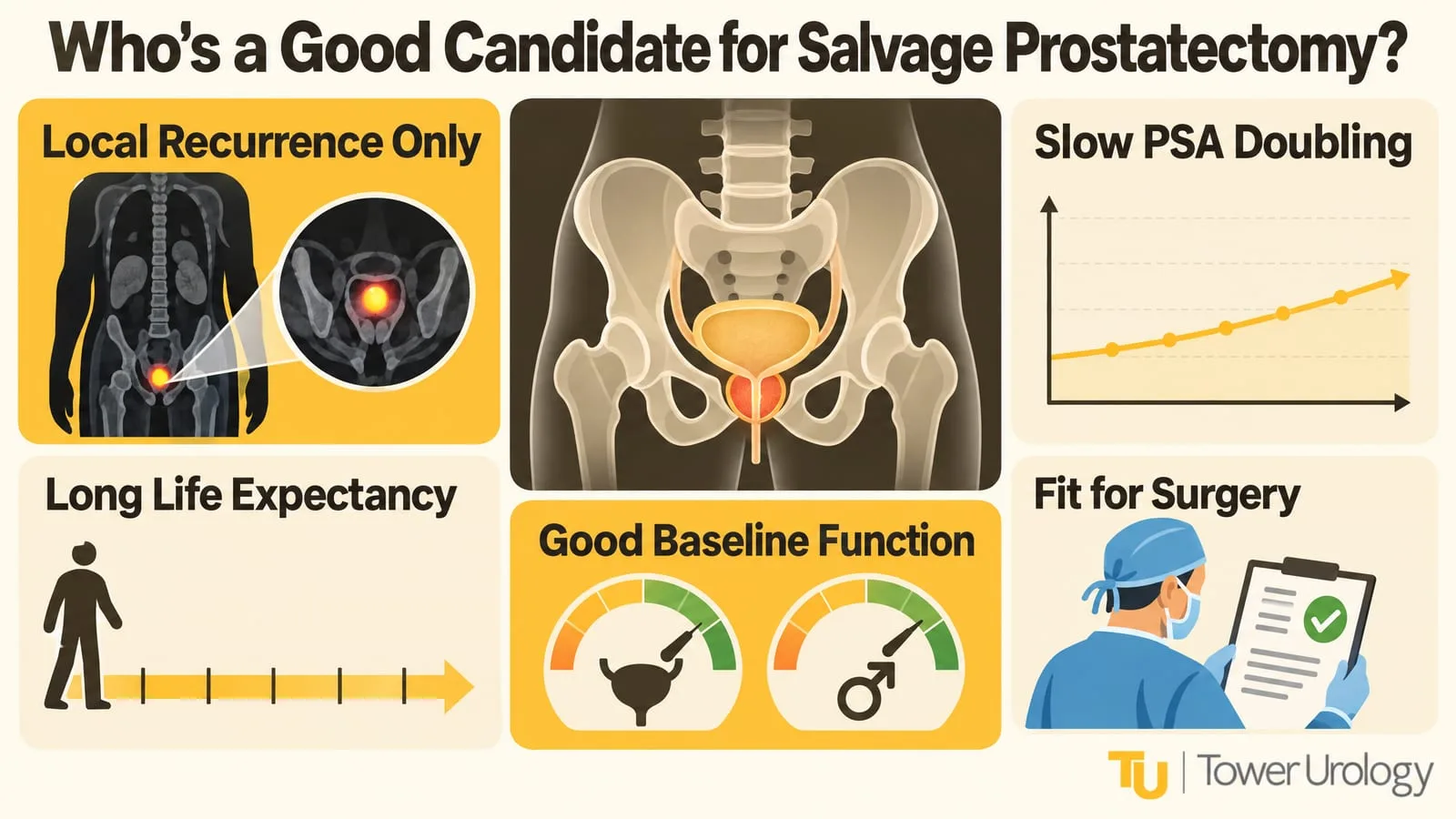
Strong candidates for salvage RARP after HIFU or radiation failure typically share these characteristics:
Biopsy-confirmed local recurrence with no evidence of metastatic spread on PSMA PET
PSA doubling time greater than six months (suggesting less aggressive disease kinetics)
Life expectancy of at least ten years
Adequate baseline urinary and sexual function before salvage surgery
No severe comorbidities that would make major pelvic surgery prohibitively risky
Willingness to accept the higher complication profile compared to primary prostatectomy
Men who had whole-gland HIFU face a more complex picture than those who had focal HIFU. The entire prostate has been thermally ablated, creating more uniform tissue disruption. Salvage surgery is still feasible and potentially curative, but the risk of urinary complications – particularly incontinence – is higher than in the focal HIFU setting.
Men who are not good candidates include those with confirmed lymph node or distant metastases on PSMA PET, those with very short PSA doubling times suggesting systemic disease, and those whose baseline health would not support a major surgical procedure. For these patients, systemic therapy, salvage radiation (where applicable), or clinical trial enrollment may be more appropriate paths.
Why Prior HIFU Changes the Surgical Challenge – and Why Surgeon Experience Matters More Than Ever
Consider a man in his early 60s who chose focal HIFU three years ago because it offered targeted treatment with minimal side effects. His PSA nadir reached 0.4 ng/mL, then began rising. Biopsy confirmed Gleason 7 recurrence in the previously untreated lobe. PSMA PET showed no distant spread. He is an excellent candidate for salvage RARP – but only if his surgeon has specific experience with post-HIFU anatomy.
The 2026 Frontiers in Oncology study on salvage RARP after targeted HIFU found the procedure feasible and oncologically effective, but also noted that operative times and complication profiles differ from primary surgery. The ablated tissue zone creates unpredictable adhesions. The rectal wall, which lies immediately posterior to the prostate, requires meticulous dissection to avoid injury – a risk that is amplified when normal tissue planes have been disrupted by thermal energy.
Nerve-sparing technique is another area where HIFU history matters. In focal HIFU, the neurovascular bundle on the treated side is often already compromised by the ablation. An experienced surgeon will assess intraoperatively whether nerve sparing on that side is oncologically safe and anatomically feasible, and may prioritize the contralateral bundle. This nuanced decision-making requires a surgeon who has performed salvage cases specifically – not just high volumes of primary robotic prostatectomy.
At Tower Urology, our robotic surgeons have performed complex salvage cases for men across Los Angeles and Southern California, including patients who traveled long distances to access this level of expertise. Jacob’s case illustrates what is possible: early detection combined with Dr. Bui’s robotic surgical expertise resulted in cancer cure, complete continence, and restored sexual function – what his care team called the “trifecta” of prostate cancer outcomes.
Lev, an electrical contractor, underwent minimally invasive robotic prostate surgery with Dr. Josephson and returned to managing his team just three weeks after the procedure. These outcomes reflect what precision robotic technique, in experienced hands, can achieve.
If you are evaluating surgeons for a salvage procedure, ask specifically how many salvage RARPs after HIFU they have performed – not just their total robotic prostatectomy volume. The two skill sets overlap but are not identical.
Oncological Outcomes: What the Latest Research Says About Cancer Control After Salvage Surgery
The evidence base for salvage RARP has grown substantially in recent years, and the picture is more optimistic than many patients expect – particularly for those with favorable disease characteristics at the time of salvage.
The February 2026 Frontiers in Oncology single-center study on salvage RARP after targeted HIFU reported that the procedure is both feasible and oncologically effective, with acceptable complication rates when performed at experienced centers. Patients with organ-confined disease at the time of salvage surgery achieved the best PSA-free survival rates.
Positive surgical margin rates – an indicator of incomplete cancer removal – were higher than in primary surgery but comparable to other salvage series, reflecting the inherent difficulty of operating in previously treated tissue.
Across the broader salvage RARP literature, five-year biochemical recurrence-free survival rates range from approximately 50% to 70% in carefully selected patients. Men with lower PSA at the time of salvage, longer PSA doubling times, and organ-confined disease on pathology consistently achieve the best outcomes. This is why the pre-operative workup – PSMA PET, prostate biopsy, PSA kinetics – is not bureaucratic box-checking. It directly predicts who will benefit most from surgery.
The 2024 AUA/ASTRO/SUO Salvage Therapy Guideline explicitly endorses salvage prostatectomy as a guideline-recommended option for men with biopsy-confirmed local recurrence after radiation or focal therapy, provided metastatic disease has been excluded. This is not an experimental or fringe approach – it is the standard of care for appropriately selected patients.
Mohamad’s experience at Tower Urology reflects what early detection and expert surgical intervention can achieve. A routine checkup prompted by family history revealed aggressive hidden prostate cancer. Dr. Desai’s expertise delivered a lifesaving cure – a reminder that the window for curative intervention, once identified, must be acted on decisively.

Functional Recovery: Continence and Sexual Function After Salvage Robotic Prostatectomy
What are the continence and erectile function outcomes after salvage robotic prostatectomy?
Functional outcomes after salvage RARP are the area where patients most need honest, specific information – and where most online content falls short. The reality is that functional recovery after salvage surgery is more challenging than after primary prostatectomy, but it is far from hopeless, especially for men who had focal rather than whole-gland HIFU.
Urinary continence: After primary robotic prostatectomy, most men regain full continence within three to twelve months. After salvage RARP, continence recovery takes longer, and the final rates are lower. In salvage series, full continence rates (no pad use) at 12 months range from about 40% to 65%, depending on prior treatment type and surgical technique.
Men who had focal HIFU – with preserved sphincter anatomy on the untreated side – tend to achieve better continence outcomes than men who had whole-gland HIFU or radiation. Pelvic floor rehabilitation, started before surgery and continued aggressively afterward, significantly improves recovery speed and final outcomes.
Erectile function: Recovery after salvage RARP depends heavily on whether nerve-sparing was possible and on baseline function before surgery. In men who had focal HIFU with an intact contralateral neurovascular bundle, nerve-sparing on that side is often achievable, and erectile function recovery – with appropriate medical support, including PDE5 inhibitors or other therapies – is realistic.
In men who had whole-gland HIFU or radiation, both neurovascular bundles are typically compromised, and erectile function recovery is less predictable. Men in this situation should discuss penile rehabilitation protocols and, if needed, the option of a penile prosthesis as a reliable long-term solution.
Honest pre-operative counseling about these functional expectations is a hallmark of quality care. At Tower Urology, we believe patients deserve specific, realistic information – not reassurances that minimize real risks.
Questions to Ask Your Urologist Before Choosing Salvage Robotic Prostatectomy
The decision to proceed with salvage RARP is not one to make quickly or without thorough evaluation. These are the questions that matter most:
Have you confirmed local-only recurrence with PSMA PET? If your urologist has not ordered or discussed PSMA PET imaging, ask why. It is now the standard pre-operative evaluation for salvage candidates.
How many salvage RARPs after HIFU specifically have you performed? Total robotic prostatectomy volume is not a substitute for salvage-specific experience. Ask for the number and ask about their complication rates.
What is my PSA doubling time, and what does it tell us about my disease? A doubling time under six months significantly changes the risk-benefit calculation.
Is nerve sparing feasible given where my HIFU was targeted? If you had focal HIFU, the answer may be yes on the untreated side. Your surgeon should be able to explain this based on your specific anatomy and imaging.
What are my realistic expectations for continence and erectile function at 12 months? Ask for numbers from their own patient series, not just published literature averages.
What are the alternatives, and why is surgery the right choice for me specifically? Salvage radiation, systemic therapy, and active surveillance are all legitimate options in certain scenarios. A surgeon who can’t explain why surgery is best for your case isn’t the right surgeon.
Men facing this decision in Southern California can request a consultation with our team at Tower Urology to review their imaging, PSA history, and biopsy results with a urologist experienced in complex robotic cases. Seeing real patient outcomes after robotic prostate surgery can also help set realistic expectations before your consultation.
Frequently Asked Questions About Unsuccessful Radiation or HIFU Treatment?

Yes. Salvage robotic-assisted radical prostatectomy (RARP) is a guideline-endorsed curative option for men with biopsy-confirmed local recurrence after HIFU, provided metastatic disease has been excluded by PSMA PET imaging. The 2024 AUA/ASTRO/SUO Salvage Therapy Guideline explicitly supports this approach for appropriately selected patients. Men who had focal or targeted HIFU are often particularly good candidates because the surrounding anatomy is less disrupted than after whole-gland treatment or radiation.
Salvage RARP carries a higher complication profile than primary prostatectomy. The most significant risks include urinary incontinence (higher rates and slower recovery than primary surgery), erectile dysfunction (particularly when nerve sparing is not feasible), rectal injury during dissection (rare but more likely in previously treated tissue), and anastomotic stricture at the bladder-urethral junction. These risks are meaningfully reduced when a high-volume robotic surgeon with specific salvage experience performs the procedure. Prior HIFU, especially focal HIFU, generally results in a less fibrotic surgical field than prior radiation, which can reduce some complication risks.
The 2024 AUA/ASTRO/SUO Salvage Therapy Guideline recommends that clinicians use advanced imaging, including PSMA PET, to exclude metastatic disease before pursuing any local salvage therapy. For men with confirmed local recurrence after radiation or focal therapy, salvage prostatectomy is listed as a recommended treatment option alongside salvage radiation and other focal re-treatments. The guideline emphasizes that patient selection, based on PSA kinetics, biopsy findings, and imaging, is the most important determinant of who benefits from salvage surgery.
PSA bounce is a temporary, benign rise in PSA that can occur after radiation therapy, typically within the first two years after treatment. It does not indicate cancer recurrence. However, PSA bounce is much less common after HIFU than after radiation, which means a rising PSA after HIFU is more likely to represent true biochemical recurrence and warrants prompt evaluation. Your urologist will assess the PSA rise pattern, including the rate of increase and PSA doubling time, before concluding that recurrence has occurred.
Focal HIFU treats only the index lesion within the prostate, leaving surrounding structures and untreated tissue relatively intact. When focal HIFU fails, the recurrence often occurs in the untreated portion of the gland, and the neurovascular bundles on the untreated side may be fully preserved. This creates a more favorable surgical anatomy for salvage RARP, with better prospects for nerve sparing and continence preservation. Whole-gland HIFU ablates the entire prostate, creating more uniform tissue disruption and a more challenging surgical environment, with higher rates of post-operative incontinence and erectile dysfunction.