When a UTI becomes an emergency
“I had a urinary tract infection (UTI) and I was bleeding, so I had to go to Cedars-Sinai ER,” Richard recalls. “When I got to the hospital they said, ‘Oh boy, you have real problems,’ which is not what you want to hear.” Richard was experiencing urinary retention, a serious condition where the bladder cannot empty, along with a urinary tract infection and bleeding, a combination that can signal significant issues with the prostate gland.
Richard’s regular internist came to see him in the hospital and immediately knew specialized care was needed. “He said that I had significant prostate problems, and that I would want to see Dr. Rusnack,” Richard remembers. “As soon as he said that, her name stuck in my brain.”
For Richard Vitolo, what started as a frightening emergency room visit in 2018 led to a lasting relationship with a surgeon whose skill and reassuring manner would guide him through not one, but two major surgical procedures. His journey with Dr. Rusnack at Tower Urology exemplifies how the right healthcare provider helps patients move from fear to confidence, guiding them through complex medical challenges with care and clarity.
Finding Dr. Rusnack: immediate response and reassurance
After several days in the hospital seeing the staff urologist, Richard was discharged and set up an appointment with Dr. Rusnack. “She saw me almost immediately, within a day. She was very responsive,” he says. This quick access to specialized urology care made all the difference during an extremely stressful time for Richard and his wife.
“She reassured me during the process, because it took some time to find out what was wrong, as the UTI had really taken its toll,” Richard explains. For men experiencing bleeding from the urethra, the fear can be overwhelming. “Men don’t bleed from down there, so when we see blood we get very scared,” Richard notes candidly.
Understanding treatment options: when is prostate surgery necessary?
Dr. Rusnack determined that he had an enlarged prostate, or benign prostatic hyperplasia (BPH). She worked to determine the best course of action, starting with conservative approaches. “Unfortunately, she eventually said the drugs weren’t working on my enlarged prostate, and that I would need surgery,” Richard recalls. Like many men, he tried medications first, but they proved ineffective. “The medications can take at least four weeks before you know they don’t work. During that time, you’re bleeding, you have a catheter, and it’s extremely scary.”
But Richard maintains that what sets Dr. Rusnack apart is her transparent communication about treatment options. “She told me straight up—the medications weren’t working, and they weren’t,” Richard says. Rather than prolonging ineffective treatment, she recommended robotic simple prostatectomy, a surgical procedure to remove the enlarged portion of the prostate.
The advantage of state-of-the-art robotic surgery
Dr. Rusnack’s expertise in robotic prostatectomy gave Richard confidence. “She’s extremely skilled in microsurgery, and she said, ‘I’m the best at doing this prostate surgery, and you will have minimal side effects,'” Richard remembers. “And boy, she was right. I had very minimal side effects.”
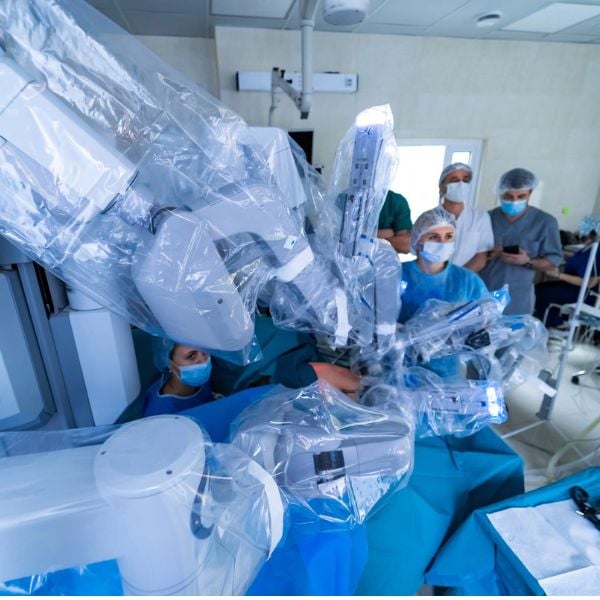
The procedure was performed using the Da Vinci surgical system, an advanced robotic system that offers significant advantages over traditional open surgery. “Because it’s laparoscopically done with the Da Vinci machine, the recovery time was very minimal, even at my age,” Richard notes.
Dr. Rusnack openly and honestly explained the technical advantages to Richard before surgery, and he appreciates how Dr. Rusnack keeps patients focused on accurate information. “The problem is that everyone runs to the internet when you find out you have something. And all the stuff there can be wrong, or at least partially wrong, and that’s a problem. When you’re fearful, you fish for answers,” he explains. “But Dr. Rusnack zeroes you in on the real issue at hand, and that’s really reassuring. She’ll give it to you straight—she’s spot on and will keep you from wandering while helping you understand what’s happening and what your options are.”
“She said doing surgery on the prostate used to be the bloodiest of all surgeries with traditional methods. But with the Da Vinci machine and laparoscopic approach, they make small incisions and pump your stomach with air, and when they do that, it helps reduce bleeding and lets them clearly see the prostate,” Richard explains. “The air pressure helps stop the bleeding before it even starts, and they can see better and perform the surgery more quickly.”
These benefits of robotic-assisted surgery, less blood loss, better visualization for the surgeon using robotic arms and surgical tools with enhanced range of motion, faster recovery, and minimal damage to surrounding organs, represent the evolution of modern surgical treatment. Compared to procedures requiring a large incision, robotic prostate surgery offers shorter hospital stays, less pain, and quicker return to normal activities.
This combination of expertise and transparency meant Richard had the information he needed without the anxiety that comes from unreliable internet searches. “She gives you enough information to reassure you and keep you from looking at the stupid internet,” Richard says with a laugh. Dr. Rusnack performed a simple robotic prostatectomy and Richard was pleased with the results.
Symptoms of another UTI point to something else
However, Richard’s relationship with Dr. Rusnack proved invaluable again in 2023. “I had what I thought was another UTI. I was constipated and taking medication and it wasn’t working. I was at my wits end and I went to the ER,” he recalls. While in the waiting room, Richard got up to use the restroom and began urinating blood.
“The ER asked if I had a urologist and I said Dr. Rusnack, and the ER went and got her,” Richard says. Dr. Rusnack came immediately to evaluate him. “We figured out that I had an enclosed tumor in my kidney. She wasn’t sure how the bleeding started, but the tumor was visible in my kidney and believed to be cancer.”
In February 2024, Dr. Rusnack performed a right nephrectomy, the surgical removal of Richard’s kidney, using the same Da Vinci robotic system to treat his kidney cancer. Once again, the state-of-the-art technology meant small incisions, minimal recovery time, and excellent outcomes. “I had minimal recovery time,” Richard emphasizes, “and very little scarring.”
Beyond her technical skill with the robotic surgical system, Dr. Rusnack’s communication style sets her apart. “Her manner is excellent. She’s extremely confident. She’s comforting,” Richard says. “When she gives you information, it’s to make sure you understand what’s happening, and it gives you comfort and confidence. She’s very reassuring.”
“So now I’m living with one kidney, and I see her every six months,” Richard reports. “I’m cancer-free and haven’t needed any treatment.” The regular follow-up appointments ensure that Richard’s health is monitored and any concerns are addressed promptly.
An enthusiastic advocate for Dr. Rusnack
Richard’s experience has made him one of Dr. Rusnack’s most vocal advocates. “There isn’t a guy that I run into that I don’t say, ‘If you ever have prostate problems, you need to go see Dr. Rusnack, don’t go to anyone else,'” he declares. “She’s really amazing, and I understand that she’s especially skilled with men’s and women’s issues and microsurgery.”
His recommendation extends even to men who aren’t currently experiencing problems. “I recommend her to everybody, everyone, even guys that don’t have problems. I recommend that they should remember her name for when the time comes — Dr. Rusnack.”
Richard’s journey from emergency urinary retention requiring a urinary catheter and robotic simple prostatectomy, to kidney tumor removal, demonstrates the comprehensive expertise available at Tower Urology. His positive outcomes, minimal side effects, faster recovery times, and ongoing cancer-free status reflect both Dr. Rusnack’s surgical excellence and the advantages of robotic-assisted procedures using advanced surgical systems.
For men facing prostate problems, whether benign enlargement requiring surgical treatment or more complex urological issues, Richard’s story illustrates the peace of mind that comes from having a skilled, communicative surgeon using state-of-the-art technology to achieve optimal outcomes.
Why choose Tower Urology for robotic surgery?
At Tower Urology, our specialists combine advanced robotic surgery capabilities with comprehensive urological expertise. Dr. Rusnack and our team of urologic surgeons utilize the Da Vinci surgical system to perform complex procedures with small incisions, enhanced visualization, less blood loss, and shorter hospital stays compared to traditional open surgery. Our state-of-the-art approach to surgical treatment, combined with compassionate preoperative and postoperative care, ensures optimal outcomes for conditions ranging from enlarged prostate to kidney tumors.
Tower Urology is a proud affiliate of Cedars-Sinai Medical Center, ranked #1 in California and #2 nationwide by U.S. News & World Report. This partnership reflects our dedication to delivering the highest standard of urologic care alongside the best urologists in Los Angeles. Our years of experience and access to Cedars-Sinai’s world-class facilities ensure that our exceptional and innovative urological care positions Tower Urology as a leader in Southern California.
Tower Urology is conveniently located for patients throughout Southern California and Los Angeles, including Beverly Hills, Santa Monica, West Los Angeles, West Hollywood, Culver City, Hollywood, Venice, Marina del Rey, Burbank, Glendale, and Downtown Los Angeles.
Our services include robotic prostatectomy, kidney tumor removal, management of urinary retention and UTIs, and comprehensive urological care using the latest robotic systems and surgical tools.
Frequently asked questions about robotic prostatectomy and urological surgery

The Da Vinci robotic system can be used for several urological procedures, including simple prostatectomy for BPH (enlarged prostate), partial or total kidney removal (nephrectomy), and reconstructive surgeries such as pyeloplasty. It provides enhanced precision for complex operations.
Robotic simple prostatectomy removes only the enlarged portion of the prostate that obstructs urine flow. This approach offers relief from urinary symptoms like a weak stream and frequent urination, with less pain and faster recovery compared to open surgery.
Recovery is typically faster than with traditional surgery. Most patients go home within 24–48 hours and resume light activity in about two weeks. Full recovery can vary depending on the type of procedure and your overall health.
All surgeries carry risks such as bleeding or infection, but robotic-assisted procedures have a lower risk of complications thanks to smaller incisions and improved precision. Your urologist will review potential risks based on your condition and medical history.
Yes. Follow-up appointments allow your care team to assess healing, remove any catheters or drains, and review test results. The frequency and duration of these visits depend on your procedure type; your Tower Urology team will provide a personalized plan.
Sources:
Intuitive da Vinci
https://www.intuitive.com/en-us/products-and-services/da-vinci
Benign Prostatic Hyperplasia
https://www.ncbi.nlm.nih.gov/books/NBK558920/
Renal Cancer
https://www.ncbi.nlm.nih.gov/books/NBK558975/
Is Early Surgical Treatment for Benign Prostatic Hyperplasia Preferable to Prolonged Medical Therapy: Pros and Cons
https://pmc.ncbi.nlm.nih.gov/articles/PMC8069902/