What are kidney stones?
Kidney stones are hard, pebble-like deposits that form inside the kidneys when there is an imbalance in the levels of certain substances in urine, such as calcium, oxalate, and uric acid. When these substances become too concentrated, they crystallize and clump together, gradually growing into solid masses over weeks, months, or even years.

Stones can range dramatically in size, from a tiny grain of sand to a pebble the size of a golf ball. Size matters enormously for what happens next. Stones smaller than 4mm often pass through the urinary tract on their own with adequate fluids and time. Stones in the 4-10mm range fall into a middle ground where your urologist will weigh symptoms, location, and how your body is responding. Stones larger than 10mm rarely pass without some form of treatment.
The journey a stone takes through your body explains why it causes so much pain. Once a stone leaves the kidney, it must travel down the ureter, the narrow tube that carries urine from the kidney to the bladder. The ureter is only a few millimeters wide in places, and when a stone becomes lodged there, it blocks normal urine flow and causes pressure to build up in the kidney. That pressure triggers the intense, cramping pain known as renal colic, which kidney stone patients consistently describe as some of the worst pain they have ever experienced. As the stone moves downward, the pain shifts too, typically starting in the flank or mid-back and radiating toward the lower abdomen and groin.
Kidney stones are surprisingly common, affecting roughly 1 in 10 Americans at some point in their lifetime, and rates have been rising steadily over the past few decades. The good news is that with the right care and a personalized treatment plan, most people recover fully, and you can take effective steps to prevent them from coming back.
How common are kidney stones?
Kidney stones affect more than 10% of adults in the United States during their lifetime. Anyone can develop them, although they are more common in men between the ages of 40 and 60. Historically, men have had a significantly higher rate than women, though newer data suggest the gender gap is narrowing. In the United States, kidney stone prevalence increases from North to South and East to West, reflecting the role that heat, dehydration, and climate play in stone formation.
Are all kidney stones the same?
Not at all, and understanding which type you have matters, because each forms differently and responds to different treatments and prevention strategies. There are five main types of kidney stones:
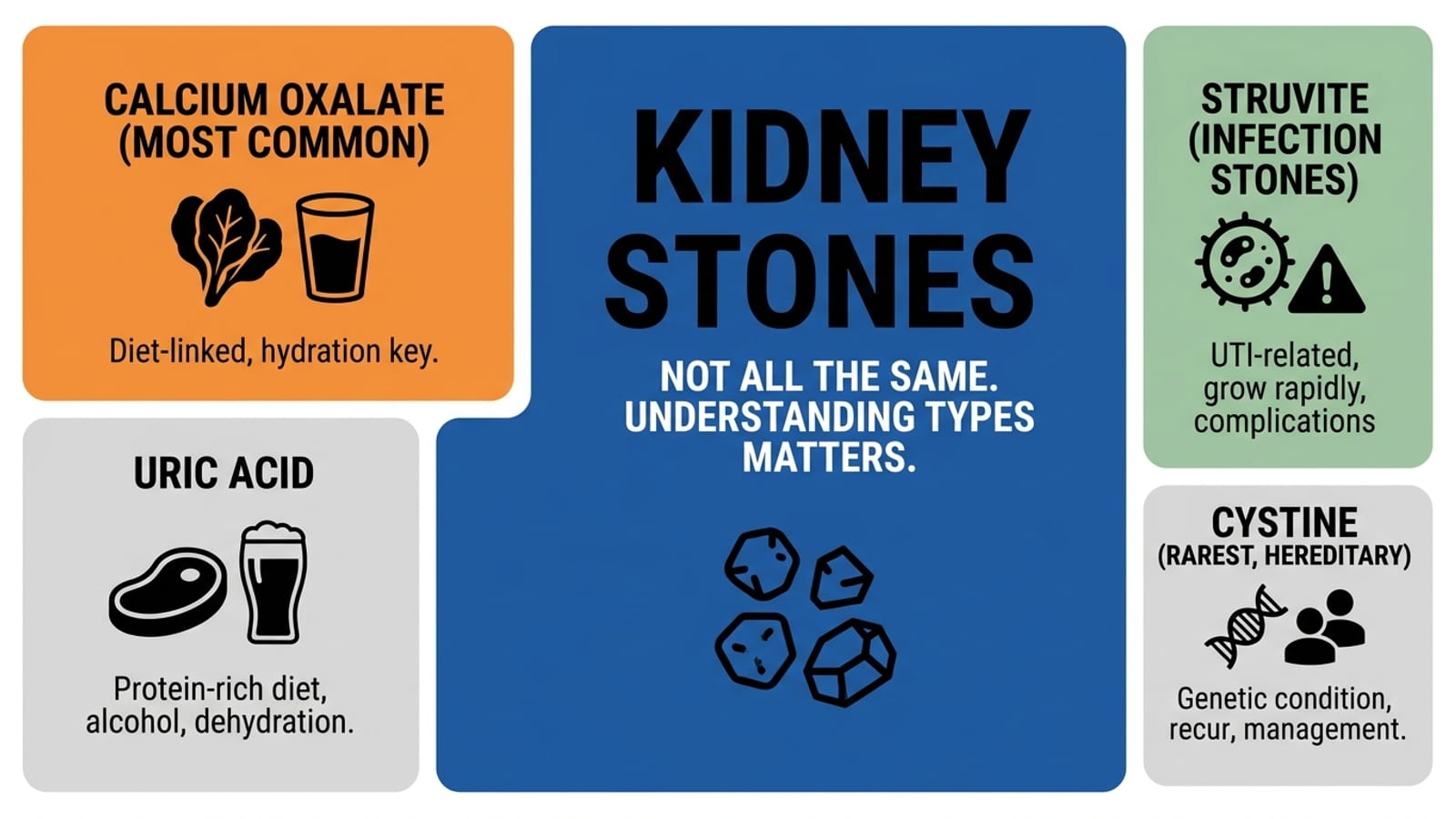
Calcium oxalate stones are the most common type by far, accounting for most kidney stones. They form when calcium binds with oxalate in the urine, and are closely linked to diets high in oxalate-rich foods such as spinach, beets, chocolate, nuts, and black tea. Staying well hydrated is one of the most effective ways to reduce your risk. Contrary to popular belief, avoiding dietary calcium is not the answer; calcium consumed with meals actually binds oxalate in the gut and helps prevent it from reaching the kidneys.
Calcium phosphate stones are less common than calcium oxalate stones and are often linked to underlying abnormalities in urinary function, such as renal tubular acidosis or hypercalciuria, in which the kidneys excrete abnormally high levels of calcium. They can also appear alongside calcium oxalate stones in the same patient.
Uric acid stones are more prevalent in men and form when urine becomes too acidic. Risk factors include a diet high in animal protein, conditions such as gout or Crohn’s disease, dehydration, and excessive alcohol consumption, which raises uric acid levels and reduces urine output at the same time. Unlike calcium-based stones, uric acid stones can sometimes be dissolved with medication such as potassium citrate, which alkalinizes the urine.
Struvite stones, sometimes called infection stones, are composed of magnesium, ammonium, and phosphate. They typically develop from urinary tract infections caused by bacteria that produce ammonia, raising urine pH. Struvite stones are particularly concerning because they can grow rapidly and, if left untreated, lead to serious complications including chronic infection and lasting kidney damage, making prompt treatment essential.
Cystine stones are the rarest type, caused by a hereditary condition called cystinuria, in which the kidneys excrete too much of the amino acid cystine into the urine. Because they tend to recur and can be difficult to dissolve, patients with cystine stones often benefit from long-term specialist management.
Knowing your stone type is not just academic. It directly shapes the personalized care plan your urologist will recommend, from dietary adjustments to the most appropriate minimally invasive treatment. At Tower Urology, our team uses comprehensive metabolic testing and imaging to identify exactly what you are dealing with, so nothing is left to guesswork.
What are the symptoms of kidney stones?
Kidney stone symptoms depend largely on where the stone is and whether it is moving. A small stone sitting quietly inside the kidney often causes no symptoms at all. Many people discover they have one incidentally during an imaging scan for something else entirely. These are called asymptomatic stones, and while they may not need immediate treatment, they do warrant monitoring.
The trouble starts when a stone breaks free and travels into the ureter. When that happens, most patients experience what is known as renal colic, a sudden, intense cramping pain that comes in waves and can be genuinely debilitating. Unlike a muscle ache that stays in one place, kidney stone pain tends to shift as the stone moves. It typically begins in the flank or mid-back, just below the rib cage, then radiates forward toward the lower abdomen and groin as the stone descends toward the bladder. Some patients describe it as the worst pain they have ever felt, surpassing even broken bones or childbirth.
If a kidney stone enters the ureter and begins to pass, patients typically experience one or more of the following:
Severe, wave-like pain in the side, back, or lower abdomen (renal colic)
Pain or a burning sensation while urinating
Frequent or urgent need to urinate
Blood in the urine (hematuria), which may appear pink, red, or brown
Nausea and vomiting
Cloudy or foul-smelling urine
Certain symptoms are red flags that require emergency care. Fever and chills alongside flank pain can signal a kidney infection (pyelonephritis) or a blocked, infected kidney, which is a serious medical emergency requiring urgent treatment. Inability to keep fluids down, uncontrolled pain that does not respond to over-the-counter medication, or a complete inability to urinate are also reasons to seek immediate attention rather than waiting for a scheduled appointment.
When should I go to the ER for a kidney stone?
Most kidney stones, while extremely painful, can be managed with outpatient care. However, some situations require emergency attention. Go to the emergency room or call 911 immediately if you experience any of the following:
Fever (above 38°C / 100.4°F) or chills alongside flank or back pain
Severe, uncontrollable pain that does not ease with rest or over-the-counter pain relief
Persistent vomiting that prevents you from keeping fluids down
Complete inability to urinate
Signs of sepsis, including confusion, rapid heart rate, or extreme weakness
Fever combined with a blocked ureter is a urological emergency. Bacteria can build up rapidly behind the obstruction, leading to a life-threatening kidney infection. If you are in any doubt, err on the side of caution and seek care immediately. Our team at Tower Urology is also available to guide you on next steps if you are unsure whether your symptoms warrant an ER visit.
What are the common risk factors for kidney stones?

Many risk factors contribute to kidney stone formation. In the United States, kidney stone prevalence increases from North to South and East to West, a pattern that reflects the powerful influence of climate and lifestyle on stone risk. Understanding why these factors matter can help you take meaningful steps to protect yourself. Here is a closer look at the most important ones:
Dehydration and climate. When you do not drink enough fluids, your urine becomes concentrated, leaving less room for minerals to stay dissolved. This is why kidney stones are more common in hot, dry climates. People living in the South and Southwest of the United States are at notably higher risk, particularly during summer months when sweat loss is greatest. Adequate fluid intake, enough to produce pale yellow urine throughout the day, is the single most effective preventive measure available.
Diet. A diet high in sodium raises the amount of calcium your kidneys filter into the urine, increasing stone risk. Diets heavy in animal protein, including red meat, poultry, and shellfish, raise uric acid levels and reduce citrate, a natural stone inhibitor. High dietary oxalate from foods such as spinach, nuts, and chocolate increases the risk of calcium oxalate stones. Excess sugar, especially fructose, has also been linked to higher stone rates.
Obesity and diabetes. Both conditions alter how the body handles calcium, oxalate, and uric acid, making stone formation more likely. Insulin resistance in particular is strongly associated with uric acid stones, because it impairs the kidney’s ability to excrete acid properly.
Family history and genetics. If a parent or sibling has had kidney stones, your own risk is significantly higher. Certain inherited conditions, such as cystinuria or primary hyperoxaluria, directly cause recurrent stone formation and warrant specialized evaluation. Always mention a family history of kidney stones to your urologist.
Medical conditions. Hyperparathyroidism causes the body to release excess calcium into the bloodstream and urine, making calcium stones far more likely. Inflammatory bowel disease (IBD) and conditions requiring bowel surgery affect how the gut absorbs oxalate, dramatically raising oxalate levels in the urine. Gout, chronic urinary tract infections, renal tubular acidosis, and hypercalciuria also contribute to stone formation.
Alcohol consumption. Excessive alcohol, particularly beer and spirits, raises uric acid levels while simultaneously reducing urine output, a combination that significantly increases the risk of uric acid stones.
If you recognize several of these risk factors in your own health history, a personalized evaluation with our team can help identify your specific stone type and guide a prevention plan tailored to you.
How can you prevent kidney stones?
Prevention is one of the most important conversations we have with our patients, because kidney stones have a high recurrence rate. Without targeted lifestyle changes, roughly half of people who have had one stone will develop another within five to seven years. The encouraging news is that consistent, evidence-based habits can dramatically reduce that risk.
Stay well hydrated. This is the single most important thing you can do. Aim to drink enough fluid that your urine looks pale yellow throughout the day. For most people, that means around 2.5 to 3 litres of fluid daily. If you live in a warm climate like Los Angeles, work outdoors, or exercise regularly, you will need even more to compensate for what you lose through sweat. Water is the best choice; sugary drinks and excessive caffeine can work against you.
Reduce dietary sodium. A high-salt diet is one of the most underappreciated drivers of kidney stones. Cutting back on processed foods, restaurant meals, and added salt reduces the calcium your kidneys excrete, meaningfully lowering your stone risk.
Manage dietary oxalate. If you are prone to calcium oxalate stones, limit high-oxalate foods such as spinach, rhubarb, nuts, and chocolate. Importantly, do not eliminate calcium from your diet. Eating calcium-rich foods with meals helps bind oxalate in the gut before it reaches the kidneys.
Limit animal protein and alcohol. Reducing red meat, shellfish, and excessive alcohol, especially beer and spirits, lowers uric acid levels and supports a healthier urine pH, reducing the risk of uric acid stones.
Maintain a healthy weight. Obesity is a well-established risk factor for kidney stones. Regular physical activity and a balanced diet support your kidneys as much as the rest of your body.
Consider medical prevention if recommended. For patients with recurrent stones or specific metabolic abnormalities, your urologist may recommend medications such as potassium citrate, which raises urine pH and inhibits stone formation, or thiazide diuretics for hypercalciuria. We prescribe these based on 24-hour urine test results and blood work, not as a one-size-fits-all solution.
At Tower Urology, we can analyze your stone composition and urine chemistry to build a prevention plan tailored specifically to you, giving you the best possible outcomes going forward.
How do our urologists diagnose kidney stones?
Accurate diagnosis underpins effective treatment. When kidney stones are suspected, our urologists use imaging, blood tests, and urine analysis to build a complete picture of what is happening and why.
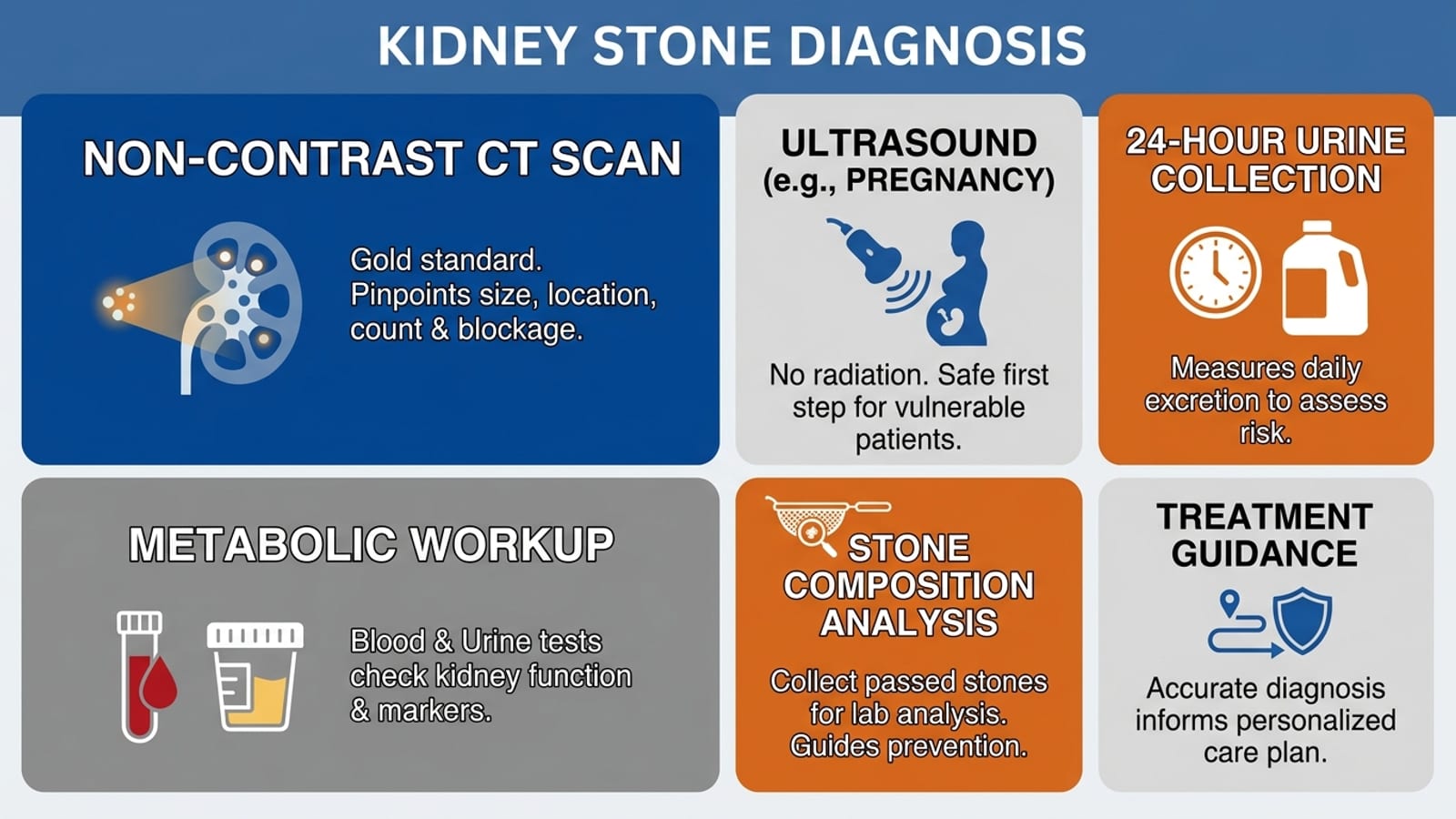
Non-contrast CT scan. This is the gold-standard imaging tool for kidney stones. A CT scan can pinpoint the exact size and location of a stone, identify how many stones are present, and reveal whether the ureter is blocked, all critical details that guide your treatment plan. It is fast, widely available, and highly accurate even for very small stones.
Ultrasound. In certain situations, such as during pregnancy, our doctors will opt for an ultrasound instead to avoid radiation exposure. While ultrasound is less precise for detecting small stones, it is a safe and effective first step for vulnerable patients and can identify significant obstruction or hydronephrosis (swelling of the kidney due to a blockage).
Blood and urine tests. Imaging alone does not tell the whole story. Your urologist will also order blood and urine tests as part of a metabolic workup, checking kidney function, calcium levels, uric acid, and other markers that help explain why you formed a stone in the first place. Elevated blood calcium may point to hyperparathyroidism; high uric acid may explain uric acid stones.
24-hour urine test. A 24-hour urine collection is often requested to measure what your kidneys excrete over a full day, including calcium, oxalate, citrate, uric acid, and urine volume. This gives a clearer picture of your individual stone-forming risk and is particularly valuable for patients with recurrent stones or a strong family history.
Stone composition analysis. If you pass a stone on your own, try to collect it. Strain your urine through a fine mesh or coffee filter and bring the stone to your appointment so the lab can identify whether it is calcium oxalate, uric acid, struvite, cystine, or another type. Knowing the stone’s exact makeup is one of the most valuable tools for preventing future stones and personalizing your care plan.
How do we treat kidney stones?
Tower Urology features fellowship-trained endourology experts who specialize in managing kidney stones. Our team takes a personalized, comprehensive approach, matching each patient to the right treatment based on their stone’s size, location, composition, and overall health.
Not every kidney stone requires a procedure. The first decision your urologist will make is whether your stone can pass on its own or needs active intervention. Stone size is one of the most reliable guides: stones smaller than 4mm pass spontaneously in most cases, while stones larger than 10mm rarely pass without treatment. Stones in the 4-10mm range fall into a middle ground where your doctor will weigh symptoms, location, and how your body is responding before recommending a path forward.
Watchful waiting and medical expulsive therapy
For patients who are candidates for watchful waiting, our team will outline a clear management plan. This typically includes staying well hydrated, drinking enough fluid to produce at least two liters of urine per day, and straining urine to catch the stone for analysis. Most stones pass within two to four weeks of symptoms starting, though smaller stones can pass in just a few days.
Pain management is an important part of this waiting period. Kidney stone pain can be intense and unpredictable, and your care team will discuss appropriate options to keep you comfortable while your body does the work.
Alongside pain relief, your urologist may prescribe an alpha-blocker. Tamsulosin is the most commonly used, and it works by relaxing the smooth muscle in the ureter, widening the passage and helping the stone move through more quickly and with less discomfort. This approach is called medical expulsive therapy, and research consistently shows it improves passage rates for stones in the lower ureter, particularly those between 5mm and 10mm.
Minimally invasive and surgical treatments
When a stone is too large to pass, is causing a blockage, leads to infection, or simply is not moving despite conservative management, Tower Urology offers all common and advanced kidney stone treatments:
- Extracorporeal Shock Wave Lithotripsy (ESWL) involves directing high-energy shock waves at a kidney stone from outside the body to break it into smaller fragments that can then pass naturally through urine. It is a non-invasive outpatient procedure well suited to stones in the kidney or upper ureter, typically those under 20mm. Most patients return to normal activities within a day or two.
- Laser lithotripsy uses a precisely targeted laser to break stones into very small pieces. The fragments can then be removed at the same time or passed out in urine. It is often performed in conjunction with ureteroscopy and is highly effective for a wide range of stone sizes and locations.
- Ureteroscopy uses a thin, flexible instrument called a ureteroscope, which is passed through the urethra and bladder into the ureter without any incisions. This allows your urologist to visualize the stone directly and either remove it with a small basket or fragment it with a laser. This minimally invasive approach is particularly effective for mid- and lower-ureter stones and typically requires no overnight hospital stay.
- Percutaneous Nephrolithotomy (PCNL) is a minimally invasive surgical approach that accesses the kidney through a small incision in the back to remove large or complex stones directly. It is generally reserved for stones larger than 20mm, staghorn stones, or those that have not responded to other treatments. Recovery is typically faster than traditional open surgery, with most patients returning to normal activity within a few weeks.
Whichever path is right for you, our fellowship-trained endourology specialists will walk you through every option with unparalleled expertise and compassionate care, so you can make a confident, informed decision about your treatment.
Tower Urology offers the most experienced care for kidney stones in Los Angeles
At Tower Urology, we take a personalized, evidence-based approach to kidney stone care. Our fellowship-trained endourology specialists combine clinical excellence with genuine compassion, taking the time to understand your individual history, risk factors, and goals before recommending a treatment path. We deliver unparalleled expertise and compassionate care, ensuring the best possible outcomes for every patient.
We invite you to establish care with Tower Urology.
Tower Urology is conveniently located for patients throughout Southern California and the Los Angeles area, including Beverly Hills, Santa Monica, West Los Angeles, West Hollywood, Culver City, Hollywood, Venice, Marina del Rey, Burbank, Glendale, and Downtown Los Angeles.
Our services include treatment for incontinence and overactive bladder (OAB), hematuria, urinary tract infections, nocturia, and urinary bladder dysfunction.
Kidney Stone FAQs

If you’re dealing with kidney stones, the type of doctor you typically see is a urologist. Urologists are kidney stone specialists, treating all urinary tract diseases (kidneys, ureters, bladder, and urethra) and the reproductive system.
They’re the healthcare professionals who diagnose, manage, and treat kidney stones.
Patients with recurrent or chronic kidney stones may benefit from seeing a urologist experienced in both treating active stones and identifying the underlying causes contributing to stone formation. When choosing a specialist, patients may want to consider factors such as access to advanced imaging technology, minimally invasive treatment options, metabolic stone evaluation, and long-term prevention strategies.
At Tower Urology, patients have access to experienced urologists who provide comprehensive kidney stone care, including diagnostic evaluation, minimally invasive stone treatment, and personalized prevention plans designed to help reduce the risk of future stones.
We always tell our patients that the best way to manage their kidney stones is to do whatever it takes to prevent them from forming. Treating kidney stones is not hard, but making the necessary changes, such as dietary and lifestyle changes, to prevent future stone formation is not always easy.
However, the best approach is to work with your urologist to devise a treatment plan to prevent them.
Yes, kidney stones can increase the risk of developing chronic kidney disease (CKD). People with kidney stones have nearly twice the risk of developing CKD compared to those without kidney stones. This relationship has been confirmed in long-term studies showing that kidney stone formers have a 51% to 68% increased risk for CKD by diagnostic codes and a 25% to 44% increased risk by elevated serum creatinine levels.
Managing chronic or recurrent kidney stones often involves more than simply treating active stones. Long-term management may include identifying underlying causes, evaluating diet and hydration habits, performing metabolic testing, and developing personalized prevention strategies to reduce the risk of future stone formation.
Depending on the size, location, and frequency of stones, treatment may include increased hydration, dietary modifications, medications, or minimally invasive procedures to remove stones when necessary. At Tower Urology, patients receive comprehensive kidney stone care focused on both effective treatment and long-term prevention.
It depends on the size. Small stones under 4mm often pass on their own within one to two weeks. Stones between 4mm and 6mm may take two to four weeks and are more likely to need medical expulsive therapy, such as tamsulosin, to help them pass. Larger stones rarely pass without intervention.
Most kidney stones are not life-threatening, but they can cause serious complications if left untreated, including kidney infections, sepsis, or long-term kidney damage. If you have severe pain, a fever, or cannot keep fluids down, go to the ER right away.
Unfortunately, yes. Without lifestyle changes, roughly half of people who have had one kidney stone will develop another within five to seven years. The good news is that personalized care, targeted dietary changes, adequate hydration, and in some cases medication can significantly reduce that risk.
It depends on your stone type. For calcium oxalate stones, limit high-oxalate foods such as spinach, nuts, and chocolate, and reduce dietary sodium. For uric acid stones, cut back on red meat, shellfish, and alcohol. Your urologist can give you specific guidance based on your stone composition and 24-hour urine results.
Not always. Many stones pass naturally with hydration, pain management, and medical expulsive therapy. When intervention is needed, our team offers minimally invasive options including laser lithotripsy, ureteroscopy, ESWL, and PCNL, all designed for faster recovery times and reduced discomfort.
Absolutely. While kidney stones are slightly more common in men, women are affected too, and their symptoms can sometimes be mistaken for other conditions such as ovarian cysts or appendicitis. Our experienced female urologists in Los Angeles provide compassionate, comprehensive care tailored specifically to women’s urological health.
A 24-hour urine test involves collecting all your urine over a full day so the laboratory can measure what your kidneys excrete, including calcium, oxalate, citrate, and uric acid. It is one of the most useful tools for understanding why you formed a stone and for designing a personalized prevention plan. It is particularly recommended for anyone who has had more than one stone or who has a strong family history.