You packed an extra pair of pants in your gym bag, not for your baby, but for yourself, because leaking during a workout has become your new normal after giving birth. You’ve done the Kegels. You’ve waited it out. And you’re still leaking every time you run, jump, or sneeze. If that’s where you are right now, this article is for you.

Postpartum urinary incontinence affects up to 50% of women after childbirth, yet most of the advice new mothers receive stops at pelvic floor exercises and “give it time.” That gap between “do your Kegels” and “you need surgery” is exactly where we work every day at Tower Urology. This guide gives you a specialist-backed roadmap: what’s actually causing the leaks, a realistic recovery timeline, and the full spectrum of treatments available when exercises alone aren’t cutting it.
By the end, you’ll know the difference between the two main types of postpartum incontinence, which milestones should prompt a urology consultation, and what minimally invasive options can deliver lasting relief – sometimes in a single office visit. If you’re ready to explore your options now, learn more about women’s urological care at Tower Urology.
Why Your Body Leaks After Baby: The Pelvic Floor Mechanics Behind Postpartum Urinary Incontinence
The pelvic floor is a hammock of muscles, ligaments, and connective tissue that supports your bladder, uterus, and rectum. During pregnancy, that hammock bears the full weight of a growing baby for nine months. During a vaginal delivery, it stretches dramatically – sometimes sustaining direct trauma through an episiotomy or perineal tear – and the pudendal nerve, which controls bladder sensation and sphincter function, can be compressed or stretched in the process.
The result is a weakened support system that can no longer reliably keep the urethra closed under pressure. When you cough, sneeze, laugh, or lift, intra-abdominal pressure spikes and urine escapes. This is the core mechanical failure behind stress urinary incontinence, the most common form of postpartum leakage.
Hormonal shifts compound the problem. Estrogen levels drop sharply after delivery, and estrogen plays a direct role in maintaining the strength and elasticity of urethral and vaginal tissue. Lower estrogen means less tissue support, which makes the urethra even less effective at staying closed. According to the National Institute of Diabetes and Digestive and Kidney Diseases, pelvic floor muscle damage during childbirth is one of the leading modifiable risk factors for long-term urinary incontinence in women.
Stress, Urge, or Mixed? Identifying Which Type of Postpartum Incontinence You Have
What is the difference between stress incontinence and urge incontinence after pregnancy?
Stress urinary incontinence (SUI) is leakage triggered by physical activity or sudden pressure – a sneeze, a squat, a sprint. The bladder itself isn’t overactive; the problem is purely mechanical. The urethral sphincter can’t hold against the pressure spike.
Urge urinary incontinence, often linked to overactive bladder (OAB), is a different animal. Here, the bladder muscle contracts involuntarily and sends an overwhelming urge to urinate – sometimes with no warning at all. You might leak before you reach the bathroom, or feel the urge intensely even when your bladder is barely full. Postpartum nerve disruption, particularly to the pudendal nerve, can trigger this pattern.
Mixed incontinence combines both. Many postpartum women experience stress leakage during exercise and urgency-driven leakage at other times. Identifying your type matters because the treatments differ. A urologist can confirm your type through a focused evaluation, which is far more precise than self-diagnosis.
The Postpartum Recovery Timeline: What’s Normal at 6 Weeks, 3 Months, and Beyond
Most obstetricians reassure new mothers that leakage will resolve on its own, and for many women, it does – partially. Here’s what the evidence actually shows at each milestone.
0 to 6 weeks: Some degree of leakage is expected and normal. The pelvic floor is acutely stressed, nerve function may be temporarily disrupted, and tissue is still healing. Starting gentle Kegel exercises during this window is appropriate and beneficial, but significant improvement takes time.
6 weeks to 3 months: Most women see meaningful improvement with consistent pelvic floor work. If leakage is still frequent or severe at your 6-week postpartum visit, ask specifically about a referral to a pelvic floor physical therapist. Generic reassurance at this stage is not enough.
3 to 6 months: Research published through PubMed indicates that women who still have significant incontinence at 3 months postpartum are substantially less likely to achieve spontaneous resolution. If you’re still leaking regularly at this point, conservative self-management has likely reached its ceiling.
Beyond 6 months: Persistent incontinence at 6 months postpartum is not a waiting game. It is a clinical condition that warrants specialist evaluation. The American Urological Association (AUA) supports early specialist referral for women with persistent symptoms rather than indefinite watchful waiting.
Kegels Are a Starting Point, Not the Finish Line: What to Do When Exercises Aren’t Enough
What exercises help with postpartum bladder leakage?
Kegel exercises, contracting and releasing the pelvic floor muscles, are the right first step. Done correctly and consistently, they can meaningfully reduce stress incontinence in the early postpartum period. The key word is “correctly.” Studies suggest that up to 30% of women perform Kegels incorrectly, bearing down instead of lifting, which can actually worsen symptoms.
Pelvic floor physical therapy takes Kegels to an entirely different level. A trained pelvic floor PT uses biofeedback, manual therapy, and individualized exercise programming to address muscle imbalances, scar tissue from episiotomy, and coordination deficits that generic Kegel instructions can’t touch. If you haven’t worked with a pelvic floor PT, that’s the next step before any procedural intervention.
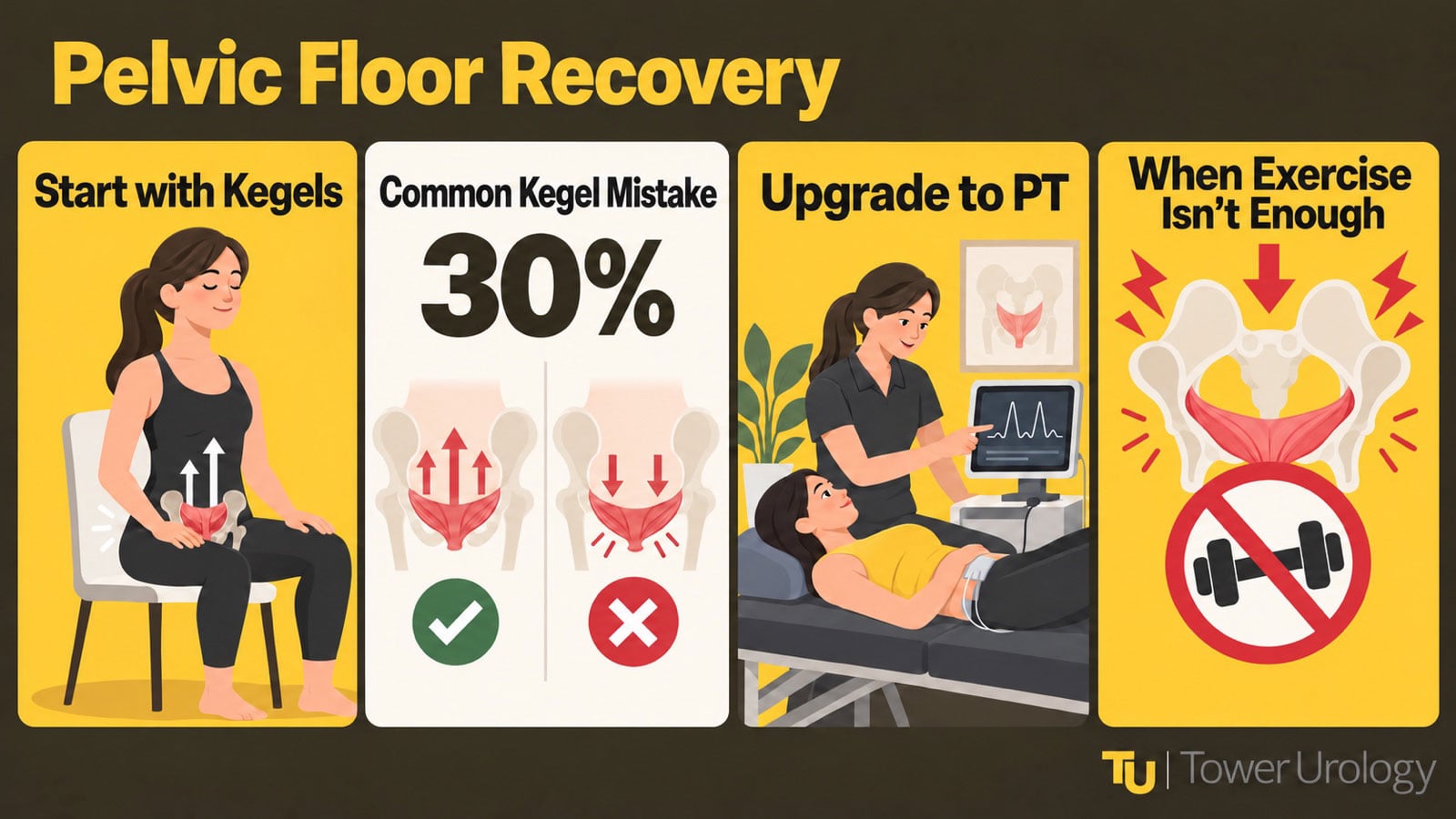
But here’s what most content on this topic won’t tell you: pelvic floor exercises address muscle weakness. They cannot repair structural damage to the urethral support mechanism, reverse significant pudendal nerve injury, or correct anatomical changes that occurred during delivery. When the problem is structural rather than purely muscular, exercises have a hard ceiling – and that ceiling is lower than most women are told.
Chelsea, a patient we treated at Tower Urology, knew that ceiling well. After years of postpartum gym leaks and packing extra pants for every workout, she had tried every exercise approach available. After one quick office procedure, she got immediate relief and lasting confidence. Her story is not unusual – it’s what happens when the right treatment is matched to the right diagnosis.
From Office Procedures to Minimally Invasive Surgery: Your Full Treatment Spectrum
Can postpartum urinary incontinence be cured without surgery?
Yes – and this is the answer that most online resources fail to give clearly. Between “do your Kegels” and “schedule a surgery,” a meaningful middle ground exists: office-based and minimally invasive procedures that can deliver lasting results with minimal downtime.
Urethral bulking agents are injected directly into the tissue around the urethra to increase its resistance and improve closure. The procedure is performed in an office or outpatient setting, takes under 30 minutes, and requires no incisions. It’s particularly effective for stress urinary incontinence in women who want to avoid surgery or who are not ideal surgical candidates.
The urethral sling procedure is the gold standard surgical treatment for stress urinary incontinence and is minimally invasive by design. A small strip of mesh or tissue is placed under the urethra to provide the support the weakened pelvic floor can no longer deliver. It’s an outpatient procedure; recovery typically takes days to weeks, not months, and success rates are consistently high. The American Urological Association recognizes the mid-urethral sling as a first-line surgical option for stress urinary incontinence.
Overactive bladder treatments for urge incontinence include bladder training protocols, anticholinergic or beta-3 agonist medications, and in-office neuromodulation procedures that calm the overactive bladder nerve signals without surgery.
Our team at Tower Urology evaluates each patient individually to determine the right starting point on this spectrum. There is no single protocol – personalized care means matching the treatment to the specific type, severity, and underlying cause of your incontinence. Explore the full range of women’s pelvic and sexual health treatments we offer.
Does Delivery Method Matter? How Vaginal Birth vs. C-Section Affects Your Risk
Does a C-section prevent postpartum urinary incontinence?
Vaginal delivery is the primary mechanical risk factor for postpartum stress urinary incontinence. The stretching and potential trauma to the pelvic floor muscles, pudendal nerve, and urethral support structures during a vaginal birth – particularly a prolonged second stage, instrumental delivery with forceps, or a large baby – significantly elevates risk compared to cesarean delivery.
C-section does reduce the risk of immediate postpartum stress incontinence. However, it does not eliminate it. Pregnancy itself, independent of delivery mode, places sustained load on the pelvic floor for nine months. Women who deliver by C-section can still develop incontinence, particularly urge incontinence or mixed incontinence, and the protective effect of cesarean delivery diminishes over time as women age.
The practical takeaway: delivery method is one risk factor among several. Body weight, number of prior deliveries, baby size, labor duration, and genetic predisposition all contribute. A C-section is not a guarantee against postpartum incontinence, and a vaginal delivery does not make persistent incontinence inevitable.
Getting Back to the Gym Without Leaking: A Specialist’s Guide for Active Postpartum Women
Returning to high-impact exercise after childbirth is a specific challenge that generic incontinence advice doesn’t address. Running, jumping, HIIT workouts, and heavy lifting all generate the kind of intra-abdominal pressure spikes that trigger stress leakage – and avoiding exercise indefinitely is not a solution for women whose physical and mental health depends on staying active.
The standard guidance to “wait 6 weeks and then return to exercise” is not calibrated to pelvic floor recovery. Many women are cleared for exercise at 6 weeks postpartum, before their pelvic floor can handle high-impact loading. Returning too aggressively can worsen symptoms and delay recovery.
A more useful framework: start with low-impact activity (walking, swimming, cycling) and progress to higher impact only when you can complete that activity without leaking. If you’re leaking during low-impact exercise at 3 months postpartum, that’s a signal to seek evaluation rather than push through. Pelvic floor PT can guide a structured return-to-exercise program. If structural issues are limiting your progress, a urology consultation can determine whether an office procedure would let you return to full activity faster than continued conservative management. Don’t let embarrassment or the assumption that “this is just how it is now” keep you from the active life you want.
When to Call a Urologist: The Signs That Postpartum Incontinence Needs Expert Care
When should I see a doctor for postpartum incontinence?
See a urologist – not just your OB-GYN – if any of the following apply: leakage is still frequent or severe at 3 months postpartum despite consistent pelvic floor exercises; you’re avoiding exercise, social activities, or travel because of bladder leakage; you’ve completed a course of pelvic floor physical therapy without adequate improvement; or your symptoms are worsening rather than improving over time.
A urologist brings a different toolkit than an OB-GYN. Where an OB-GYN manages the postpartum period broadly, a urologist specializes in the bladder, urethra, and pelvic floor as a system – and has access to the full procedural spectrum from urethral bulking to sling surgery. The American College of Obstetricians and Gynecologists recommends that women with persistent incontinence beyond the early postpartum period be referred for specialist evaluation.
At Tower Urology, our team of nationally recognized specialists evaluates postpartum incontinence with precision diagnostics and a full range of treatment options. You don’t have to accept leaking as the price of motherhood. If you’re ready to stop managing and start resolving, schedule a consultation with our women’s urology team today.
Frequently Asked Questions

For many women, mild leakage improves significantly within the first 3 months postpartum with consistent pelvic floor exercises. However, women who still have frequent or bothersome symptoms at 3 months are less likely to achieve spontaneous resolution without intervention. A urologist should evaluate persistent incontinence beyond 6 months postpartum, as it is unlikely to resolve on its own and responds well to targeted treatment.
Some degree of leakage in the first weeks after a vaginal delivery is common and expected. The pelvic floor has been under significant stress, and temporary loss of bladder control during this acute recovery phase is normal. What is not normal – and should not be accepted as permanent – is frequent, disruptive leakage that persists beyond 3 to 6 months or that prevents you from exercising, traveling, or living your daily life without anxiety about accidents.
Yes, in many cases. Pelvic floor physical therapy resolves or significantly reduces symptoms for a meaningful proportion of postpartum women. For those who don’t respond to conservative management, urethral bulking agents offer an effective, office-based, non-surgical option. Surgery – specifically the urethral sling procedure – is reserved for cases where conservative and minimally invasive approaches haven’t achieved adequate results, and even then it is a short outpatient procedure with a fast recovery.