You’ve been told the cyst on your epididymis is benign, but it’s grown large enough to cause discomfort, and your urologist has mentioned surgery. Now you need to know exactly what spermatocelectomy involves, whether it’s safe for your fertility, and what recovery actually looks like.
Spermatocelectomy is a surgical procedure performed to remove a spermatocele, which is a benign cyst that forms in the epididymis. While spermatoceles typically do not impact fertility, surgery may be considered if the cyst grows large enough to cause pain, discomfort, or a feeling of heaviness. Tower Urology advises that spermatocelectomy is generally warranted for symptomatic relief rather than primarily for fertility concerns, unless the spermatocele is causing an obstruction that affects sperm transport.
That concern is completely valid. Most online resources describe spermatocelectomy as a routine outpatient procedure and leave it there. What they don’t tell you is that the epididymis, the coiled tube where sperm mature and travel toward the vas deferens, is delicate enough that even a technically successful surgery carries a real risk of duct obstruction. For men who want biological children, that detail changes everything about how this decision should be made.
In this guide, you’ll learn exactly when surgery is genuinely warranted versus when watchful waiting is the smarter choice, what intraoperative techniques experienced urologists use to protect epididymal function, and what a realistic week-by-week recovery looks like. If you’re already exploring your options for men’s urological health conditions and treatments, from scrotoplasty to cyst excision, this article will give you the clinical context to have a much more informed conversation with your surgeon.
What Is a Spermatocelectomy and When Is It Actually Necessary?
A spermatocele is a fluid-filled epididymal cyst that forms in the epididymis, the tightly coiled tube behind each testicle that carries sperm from the testis toward the vas deferens. These cysts are extremely common, found in up to 30% of men on scrotal ultrasound, and the vast majority never cause symptoms or require any treatment at all.
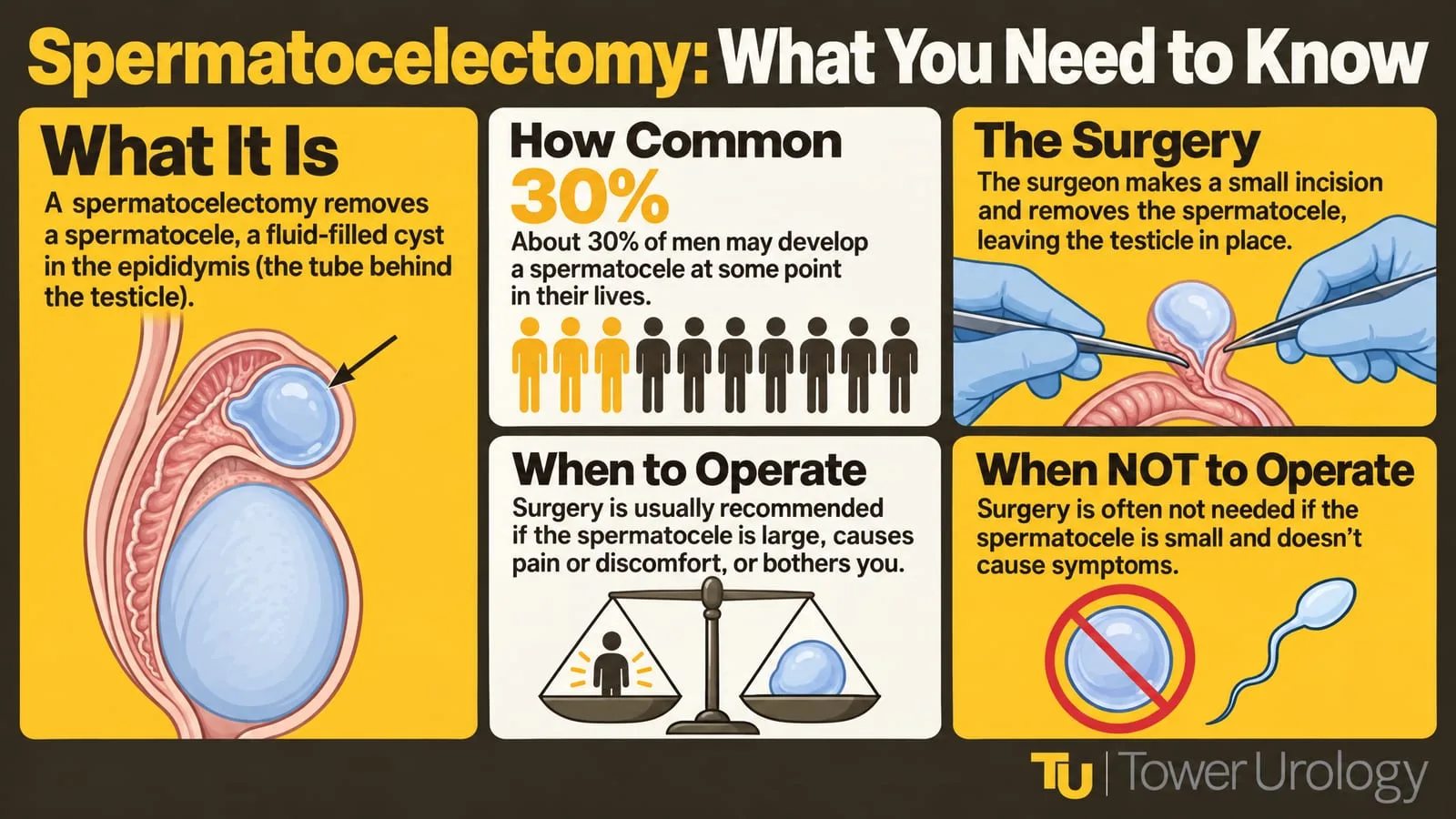
Spermatocelectomy is the surgical removal of that cyst. The procedure separates the spermatocele from the surrounding epididymal tissue and removes it entirely. It is performed as outpatient surgery, typically under general anesthesia, and takes roughly 30 to 60 minutes depending on cyst size and complexity.
When should a spermatocele be surgically removed?
Surgery is not indicated simply because a spermatocele exists. According to American Urological Association (AUA) guidance, surgical intervention is indicated only for persistent, bothersome symptoms that have not responded to conservative management.
Those symptoms typically include a dull ache or heaviness in the affected testicle, discomfort during physical activity, or a cyst large enough to cause noticeable scrotal enlargement resembling a hydrocele.
Pain that is mild and intermittent, or a cyst discovered incidentally on scrotal ultrasound without any symptoms, does not meet the bar for surgery. The condition itself poses no cancer risk and does not directly impair sperm production. The decision to operate should always be driven by quality-of-life impact, not cyst size alone.
The Spermatocelectomy Procedure: What Happens in the Operating Room
Understanding the surgical steps helps you ask better questions before you consent. Here is what actually happens during a standard spermatocelectomy.
The patient is placed under general anesthesia, though some surgeons use local anesthesia with sedation for smaller cysts. The surgeon makes a small incision directly on the scrotum over the affected side. The surgeon carefully dissects through the scrotal layers to expose the epididymis and the attached spermatocele.
The cyst is then separated from the epididymal tissue using sharp and blunt dissection. This is the most technically demanding part of the procedure. The epididymis contains a single, continuous microscopic duct, and any inadvertent entry into or transection of that duct can cause epididymal obstruction on that side. Once the cyst is fully freed, it is excised, and the scrotal layers are closed in anatomical layers with absorbable sutures.
Microsurgical technique, using an operating microscope to magnify the epididymal structures, significantly reduces the risk of inadvertent duct injury. Not every surgeon performs spermatocelectomy under magnification, and this is one of the most important questions to ask when selecting your board-certified urologist.
The Fertility Question: What Every Man Should Know Before Scheduling Surgery
Is spermatocelectomy safe if I want to have children?
This is the question most online resources sidestep, and it deserves a direct answer. Spermatocelectomy carries a real, documented risk of epididymal obstruction on the operated side. If the epididymal duct is damaged or scarred during dissection, sperm cannot pass through that segment, effectively creating an acquired form of obstructive azoospermia on that side that might later require a complex vasoepididymostomy or testicular sperm extraction to achieve biological parenthood.
Published microsurgical data, including a study cited in the National Library of Medicine, found that microsurgical spermatocelectomy carries a minimal risk of epididymal injury and testicular atrophy when performed by experienced surgeons using optical magnification. The key phrase is “experienced surgeons.” In less specialized hands, or without microsurgical technique, the risk of duct injury is meaningfully higher.
For men with a spermatocele on only one side, the contralateral epididymis and vas deferens remain intact, so fertility is generally preserved even if the operated side sustains some duct damage. The calculus changes significantly for men with bilateral spermatoceles, men who have only one functioning testicle, or men who have already had prior scrotal surgery—such as surgery for a varicocele (microsurgical varicocelectomy) or vasectomy reversal (vasovasostomy)—that may have compromised the other side.
Consider a scenario we see at Tower Urology: a man in his early 30s presents with a right-sided spermatocele causing moderate discomfort. He and his partner are planning to start a family within the next two years. In that situation, our urologists would have a detailed conversation about the realistic fertility risk on the right side, baseline parameters from a male fertility evaluation and semen analysis, whether the left epididymis and vas deferens are confirmed to be normal on scrotal ultrasound, and whether the symptom burden truly justifies surgery before he has completed his family.
For many men in that position, a period of watchful waiting or a trial of scrotal support and anti-inflammatory medication is the right first step.
If you have concerns about fertility and are considering scrotal surgery, our team’s expertise in preventing and treating male infertility through men’s sexual health and reproductive care—including advanced sperm retrieval techniques—means we can evaluate both the urological and reproductive implications before any decision is made.
Spermatocelectomy vs. Watchful Waiting vs. Sclerotherapy: Choosing the Right Path
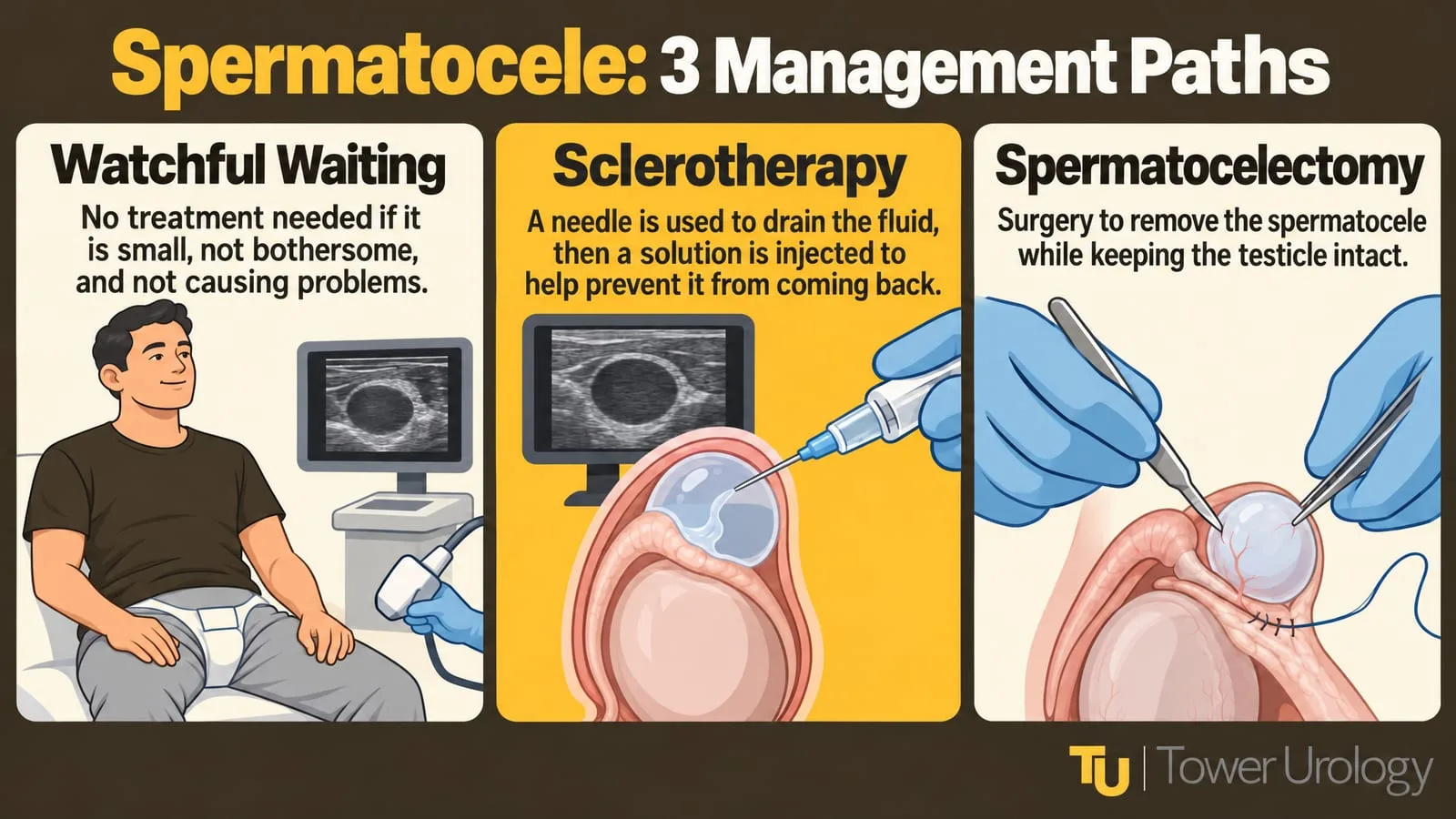
Surgery is not the only option, and for many men it should not be the first one. Here is how the three main management paths compare.
Watchful waiting is appropriate for asymptomatic spermatoceles of any size, mildly symptomatic cysts that are not worsening, and men of reproductive age who have not yet completed their families. Scrotal support, over-the-counter anti-inflammatory medications, and periodic scrotal ultrasound to monitor size are the tools of watchful waiting. Many spermatoceles remain stable for years without any intervention.
Aspiration and sclerotherapy involve draining the cyst with a needle under ultrasound guidance and then injecting a sclerosing agent to collapse the cyst wall. Some published series report single-treatment success rates above 75%.
The advantage is that it avoids a surgical incision entirely. The limitation is a higher recurrence rate compared to surgical excision, and sclerotherapy carries its own risk of epididymal inflammation if the sclerosant contacts the duct. It is generally not recommended for men who are actively trying to conceive.
Spermatocelectomy offers the most durable symptom resolution and the lowest recurrence rate among the three options. It is the right choice when symptoms persist and significantly affect quality of life, when the cyst is large enough that aspiration is unlikely to provide lasting relief, and when the patient has been fully counseled on the fertility implications and accepts that risk.
Spermatocelectomy Recovery Timeline: Week-by-Week Expectations
How long does spermatocelectomy recovery take?
Most men return to sedentary work within three to five days. Full recovery, meaning return to unrestricted physical activity and exercise, typically takes four to six weeks. Here is what to expect at each stage.
Days 1 to 3: Scrotal swelling and bruising are expected and normal. Pain is typically managed with oral analgesics. Ice applied to the scrotum in 20-minute intervals reduces swelling. Most men spend these days resting at home with the scrotum elevated.
Days 4 to 7: Swelling begins to plateau and then gradually improves. Light walking is encouraged. Driving is generally safe once you are off narcotic pain medication, usually by day four or five. Wear scrotal support continuously during this period.
Weeks 2 to 3: Most men feel significantly better and can return to desk work or light activity. Swelling continues to resolve, though some firmness around the surgical site is normal as the tissue heals. Avoid lifting anything heavier than 10 pounds.
Weeks 4 to 6: Gradual return to exercise, starting with walking and light cardio before progressing to resistance training. Sexual activity is typically cleared at the four-week follow-up visit, though individual timelines vary.
How much swelling is normal after spermatocelectomy?
Significant scrotal swelling in the first week is expected and does not indicate a complication. The scrotum may appear two to three times its normal size in the first 48 hours. Swelling that worsens after day five, fever above 101°F, or a firm, rapidly expanding mass warrants an urgent call to your surgeon, as these can signal hematoma formation or infection.
Post-Op Instructions: Swelling, Activity, Scrotal Support, and Follow-Up
Adhering to post-operative instructions makes a measurable difference in how smoothly recovery proceeds. These are the instructions our patients at Tower Urology receive after spermatocelectomy.
Wear a supportive athletic supporter or snug-fitting briefs continuously for the first two weeks, including during sleep. This reduces swelling in dependent areas and provides comfort. Apply ice wrapped in a cloth to the scrotum for 20 minutes on, 20 minutes off during the first 48 hours. Do not apply ice directly to skin.
Avoid submerging the incision in water, including baths, pools, and hot tubs, until the wound is fully healed, typically 10 to 14 days. Showering is fine after 48 hours. Avoid straining, heavy lifting, and vigorous activity for at least four weeks. Constipation increases intra-abdominal pressure and scrotal discomfort, so a stool softener during the first week is often recommended.
Your follow-up appointment is typically scheduled at two to four weeks post-operatively. If you notice increasing redness, warmth, discharge from the incision, or fever, contact your urologist before your scheduled visit.
Risks and Complications of Spermatocelectomy Explained Plainly
What are the risks and complications of spermatocelectomy?
Every surgical procedure carries risk. For spermatocelectomy, the most clinically significant risks are the following.
Epididymal obstruction is the most consequential complication for men of reproductive age. As described above, inadvertent injury to the epididymal duct during dissection can block sperm transport on the operated side. The risk is reduced but not eliminated by microsurgical technique.
Hematoma, a collection of blood in the scrotum, occurs in roughly 1 to 2% of cases. Small hematomas resolve on their own. Larger ones may require drainage. Avoiding blood-thinning medications before surgery and following post-op activity restrictions reduces this risk.
Infection is uncommon, occurring in less than 1% of cases with standard sterile technique. Signs include increasing redness, warmth, swelling, and fever beyond the first 48 hours.
Recurrence is possible, particularly if the cyst wall was not completely excised. Recurrence rates after complete surgical excision are low, generally under 5%, compared to higher rates after aspiration alone.
Testicular atrophy is rare but documented, typically resulting from disruption of the testicular blood supply during dissection. This risk is minimized by careful surgical technique and is more likely with very large or adherent cysts.
Will a spermatocele come back after surgery?
Complete surgical excision of the cyst wall gives the lowest recurrence rate of any treatment option, generally under 5% in published series. Incomplete excision, where a portion of the cyst wall is left behind, increases the likelihood of recurrence. Aspiration without sclerotherapy has a much higher recurrence rate, often exceeding 50%, because the cyst wall remains intact and can refill.
Why Choosing an Experienced Urologist Matters for This Procedure
Spermatocelectomy is classified as a minor scrotal procedure, but “minor” refers to its outpatient setting and recovery burden, not to the technical precision it demands. The epididymis is a single continuous duct about 6 meters long, coiled into a structure about 4 centimeters long. Protecting that duct during dissection requires both anatomical knowledge and surgical experience.
Surgeons who perform spermatocelectomy under optical magnification, using microsurgical principles, consistently report lower rates of epididymal injury and recurrence than those using standard loupe magnification or no magnification at all. When evaluating a urologist for this procedure, ask whether they use microsurgical technique and how many spermatocelectomies they perform annually.
The experienced urologists at Tower Urology bring subspecialty depth to scrotal and reproductive procedures, such as hydrocelectomy, PESA, and percutaneous or microsurgical epididymal sperm aspiration (MESA), including evaluating post-surgical fertility concerns and managing conditions like azoospermia that can arise from epididymal obstruction.
For men in Los Angeles, including those in Santa Monica or seeking care near Cedars-Sinai Medical Center, and throughout Southern California navigating this decision, that combination of surgical skill and reproductive medicine expertise is a meaningful advantage.
If you are ready to discuss whether spermatocelectomy is the right choice for your situation, explore our full range of men’s urological health conditions and treatments or contact our Beverly Hills office at Tower Urology directly to schedule a consultation with specialists like Dr. Justin Houman.
Frequently Asked Questions

Most spermatocelectomies in the United States are performed under general anesthesia, which allows the patient to be completely still and comfortable during the dissection of delicate epididymal tissue. Some surgeons offer local anesthesia with intravenous sedation for smaller, straightforward cysts. The choice depends on cyst size, patient preference, and the surgeon’s assessment of procedural complexity. Your urologist will discuss the anesthesia plan with you during the pre-operative consultation.
Spermatocelectomy removes only the spermatocele cyst while preserving the epididymis itself. Epididymectomy removes the entire epididymis, typically performed for chronic epididymal pain or infection that has not responded to other treatments. Epididymectomy carries a higher and more certain risk of fertility impairment on the operated side because the entire sperm-transport structure is removed. For spermatoceles, epididymectomy is rarely indicated, and spermatocelectomy is the preferred, more tissue-sparing approach.
It can be, but the answer depends on several individual factors. If you have a unilateral spermatocele and a confirmed normal contralateral epididymis and vas deferens, the fertility risk from a well-performed spermatocelectomy is relatively low. However, if you have bilateral cysts, a single functioning testicle, or prior scrotal surgery, the stakes are higher, and the decision requires careful individualized counseling. Microsurgical technique significantly reduces but does not eliminate the risk of epididymal duct injury. Men who have not yet completed their families should discuss timing and technique in detail with a urologist who has subspecialty experience in male reproductive medicine before proceeding.