What is prostate cancer?
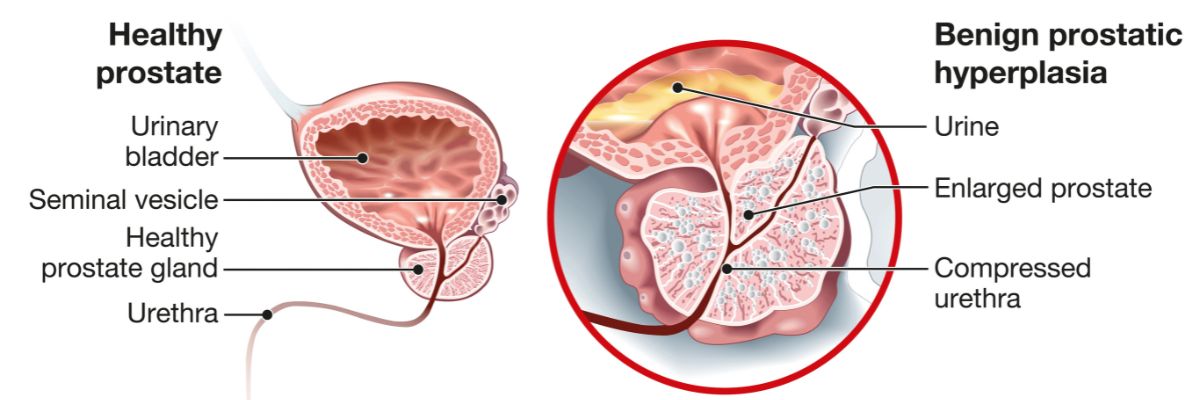
The prostate is a walnut-sized gland that all men have. It sits between the bladder and the urethra and produces seminal fluid to protect sperm.
Prostate cancer is the second-most common cancer diagnosed in American men after skin cancer, and it is the most common solid tumor cancer type in the male population. The American Cancer Society estimates that about 330,000 new cases of prostate cancer will be diagnosed in the United States in 2026.

How common is prostate cancer?
- Prostate cancer is very common, especially as men age. About 1 in 8 men will be diagnosed during their lifetime. Autopsy studies show that many older men have small, slow-growing prostate cancers that never cause symptoms or affect their health. With early detection, survival rates are excellent.
- In more than two-thirds of men diagnosed with prostate cancer, the disease is confined to just the prostate and has not spread.
- On average, prostate cancers found through common early detection cancer screening tests are smaller and more contained than cancers discovered after the patient notices symptoms.
- Adenocarcinoma of the prostate is the most common form of prostate cancer, accounting for more than 95% of all cases. This form occurs when abnormal cells slowly progress to become malignant tumors, which are often located in the outer part of the prostate. Cancerous tumors can eventually metastasize or spread beyond the prostate, both signs of advanced prostate cancer.
What are the symptoms of prostate cancer?
Prostate cancer develops slowly and may cause few, if any, symptoms. If symptoms appear, they may include one or more of the following:
- Difficulty or an inability to urinate, or pain or burning while urinating
- Blood in urine
- Painful ejaculation
- Loss of appetite
- Weight loss
- Continual lower back, pelvic, or upper thigh pain
What are the risk factors for prostate cancer?
The exact cause of prostate cancer is unknown, but it is thought that some prostate cancers may be inherited and caused by DNA mutations. However, others may be related to hormones, environment, or diet.
Prostate cancer risk factors include:
Age
The older a man is, the higher his risk of prostate cancer.
Race
There is a higher incidence of the disease in African American men than in American men of other ethnicities. Asian American men have the lowest rates.
Family history
The risk increases if a person’s father or brother has the disease.
Diet
Some researchers have linked a high-fat diet to prostate cancer. Others have found that eating too many calories (regardless of the food source) raises the risk.
How do we diagnose prostate cancer?
A prostate cancer diagnosis is made through a series of tests, starting with a blood test that detects the amount of prostate-specific antigen (called a PSA test). A PSA test gives a numerical value to the amount of a protein produced by both normal and cancerous tissue. This test is the first step in screening for prostate cancer and other prostate conditions.
Most men at average risk should talk with their doctor about PSA screening starting at age 50. Men at higher risk, including African American men and those with a father or brother who had prostate cancer, should consider starting the conversation at age 40 to 45. How often you’re tested after that depends on your PSA results and personal risk, and your urologist can help you set the right schedule.
Does an elevated PSA always indicate prostate cancer?
There is no single PSA number that means you need a biopsy. For many years, a PSA above 4.0 ng/mL was the standard trigger for more testing, but many urologists now use lower thresholds, especially for younger men. Your urologist will look at your PSA alongside your age, how quickly it has changed over time, your prostate size (PSA density), your family history, and often an MRI before recommending a biopsy. This approach helps find significant cancers while avoiding unnecessary biopsies.
However, to determine the need for a biopsy, our urologists may use some (or all) of the following diagnostic tools:
Free PSA test
This test measures the percentage of free PSA (PSA not bound to other molecules) in the blood. A lower rate of free PSA indicates a greater risk of having prostate cancer.
Digital rectal exam
In this annual test, recommended by physicians, a finger is inserted into the rectum to examine the prostate gland by touch and detect any irregularities, such as firm areas that may be associated with cancer.
PSA Velocity analysis
This measures how quickly your PSA level changes over time, calculated by comparing results from multiple PSA tests, and can indicate the likelihood or aggressiveness of prostate cancer if PSA levels rise rapidly.
PSA density
This is the ratio of the PSA level in your blood to the volume of the prostate. It is calculated by dividing the PSA level by the prostate volume and is used to help distinguish between non-cancerous benign prostatic enlargement (BPH) and prostate cancer.
Prostate MRI
A multiparametric MRI creates detailed images of the prostate and scores any suspicious areas on a scale of 1 to 5, called PI-RADS. Higher scores are more likely to be significant cancer. Many men now have an MRI before a biopsy so the biopsy can target exactly the right spots. Other imaging, such as a bone scan, CT scan, or PSMA PET scan, may be used after diagnosis to check whether cancer has spread.
UroNav MRI fusion biopsy
If a biopsy is needed, Tower Urology uses the UroNav fusion system, which overlays your MRI images onto real-time ultrasound during the procedure. This lets your urologist sample the suspicious areas precisely, improving the detection of significant cancer. Learn more about our prostate biopsy process.
Understanding your results: Gleason score, Grade Group, and stage
If your biopsy finds cancer, a pathologist grades how abnormal the cells look. This is reported as a Gleason score, which is now grouped into a simpler Grade Group from 1 to 5:
Grade Group 1 (Gleason 6): slow-growing, low risk
Grade Group 2 (Gleason 3+4=7): mostly slow-growing, favorable intermediate risk
Grade Group 3 (Gleason 4+3=7): more aggressive, unfavorable intermediate risk
Grade Groups 4 and 5 (Gleason 8 to 10): aggressive, high risk
Your urologist also determines the stage, meaning how far the cancer has spread. Localized cancer is confined to the prostate. Locally advanced cancer has grown just outside it. Advanced cancer has spread to lymph nodes or other parts of the body. Your Grade Group, stage, and PSA together place you in a risk group, which guides which treatments make the most sense.
What are the options for prostate cancer treatment?
Choosing the best treatment option(s) for a patient diagnosed with prostate cancer depends on several factors, including:
- The man’s age and life expectancy
- His feelings about the side effects associated with each treatment
- The grade and stage of the cancer
- Other health conditions
Options range from close monitoring to surgery, radiation, and newer focal treatments. Your urologist will help you weigh them against your risk group and goals.
Active surveillance
Many low-risk prostate cancers grow so slowly that they may never cause harm. Active surveillance means monitoring the cancer closely with regular PSA tests, prostate MRI, and repeat biopsies when needed, and starting treatment only if it shows signs of growing. This lets many men avoid or delay the side effects of surgery or radiation.
The American Urological Association recommends active surveillance as the preferred approach for low-risk prostate cancer. It may also be an option for some men with favorable intermediate-risk cancer. In the 15-year ProtecT trial, about 97% of men survived prostate cancer whether they chose monitoring, surgery, or radiation, and about 1 in 4 men on monitoring never needed treatment.
Robotic prostatectomy
A radical prostatectomy removes the entire prostate and sometimes nearby lymph nodes. A pathologist then examines the whole gland, which gives the most accurate picture of your cancer.
Tower Urology performs robotic-assisted radical prostatectomy, the most widely used approach today. Compared with open surgery, it typically means less blood loss, a shorter hospital stay, and faster recovery. We offer both multi-port surgery, which uses several small incisions, and single-port surgery, which uses the da Vinci SP system to operate through one small incision. Single-port surgery may mean less discomfort and a quicker return to normal activity for the right candidates. Your surgeon will recommend the approach that best fits your anatomy and cancer.
Radiation therapy
Radiation destroys cancer cells without surgery. External beam radiation is delivered over a series of outpatient sessions, while brachytherapy places radioactive seeds directly in the prostate. For intermediate- or high-risk cancer, radiation is often combined with short-term hormone therapy. Tower Urology uses SpaceOAR Hydrogel, which creates space between the prostate and rectum to help protect the rectum during radiation.
Focal therapy
Focal therapy treats only the part of the prostate that contains cancer, instead of removing or radiating the whole gland. The goal is to control the cancer while lowering the risk of lasting urinary and sexual side effects. Tower Urology offers three approaches: HIFU (high-intensity focused ultrasound), TULSA (MRI-guided ultrasound delivered through the urethra), and NanoKnife (irreversible electroporation).
Focal therapy is usually considered for men with a single, clearly defined area of intermediate-risk cancer that both MRI and biopsy confirm. Long-term evidence is less mature than for surgery or radiation, so regular PSA tests, MRI scans, and follow-up biopsies are essential. Learn more about focal therapy for prostate cancer, including who qualifies.
Treatments for advanced prostate cancer
When prostate cancer has spread or comes back after treatment, other options can slow or control it. These include hormone therapy, which lowers the hormones that fuel prostate cancer growth, as well as chemotherapy and immunotherapy. Tower Urology’s urologists work with medical oncologists to build a plan for each patient.
How to compare your treatment options
For localized prostate cancer, surgery and radiation offer similar cancer control. In the ProtecT trial, fewer than 3 in 100 men died of prostate cancer within 15 years, whether they had surgery, radiation, or active monitoring. Men on monitoring were more likely to see their cancer spread, though today’s surveillance with MRI is more thorough. The choice usually comes down to your age, health, cancer characteristics, and which side effects matter most to you.
Side effects
- Urinary: Surgery commonly causes temporary leakage that improves over weeks to months. Radiation is more likely to cause urinary frequency, urgency, or irritation. Focal therapy aims to lower the risk of lasting urinary problems.
- Sexual function: Erection changes can follow surgery or radiation. After surgery, they appear right away and often improve over one to two years, especially with nerve-sparing technique. After radiation, they tend to develop gradually over several years. Focal therapy aims to better preserve sexual function, though it isn’t guaranteed.
- Bowel: Radiation can irritate the rectum, causing urgency or occasional bleeding, and SpaceOAR hydrogel can reduce this risk. Surgery rarely affects bowel function.
- Active surveillance avoids treatment side effects unless and until treatment is needed.
Recovery and time commitment
Surgery involves one operation, usually a one-night hospital stay, and a few weeks of recovery. External radiation requires five to about 28 outpatient sessions, depending on the regimen, with little downtime but more visits. Focal therapy is usually a same-day procedure, often with a temporary catheter. Active surveillance requires ongoing PSA tests, MRI scans, and periodic biopsies.
If cancer comes back
After surgery, your PSA should drop to an undetectable level, so any recurrence is easy to spot, and radiation remains available as a second treatment. Surgery after radiation is possible but technically more difficult and carries more risk of side effects. After focal therapy, options include repeat focal treatment, surgery, or radiation, though earlier treatment can make later surgery more complex.
Who each option tends to suit
Active surveillance suits most men with low-risk cancer. Surgery is often favored for younger, healthy men who want the prostate removed and fully examined. Radiation may suit men who prefer to avoid an operation, are older, or have health conditions that raise surgical risk. Focal therapy may suit carefully selected men with limited intermediate-risk cancer who want to preserve urinary and sexual function. Because Tower Urology’s team includes urologic surgeons, radiation oncologists, and medical oncologists, you can review your options with specialists in each before deciding.
What to expect after prostate cancer surgery
- In the hospital: Most patients stay one night after robotic prostatectomy, and some go home the same day. You’ll be walking within hours of surgery.
- The first few weeks: A urinary catheter stays in place for about one week while the connection between the bladder and urethra heals. Most men return to desk work and light activity within two to three weeks, and can resume heavy lifting and strenuous exercise after about six weeks.
- Regaining urinary control: Some leakage is normal after the catheter is removed. Pelvic floor (Kegel) exercises speed recovery, and most men regain good control within a few months, with continued improvement up to a year.
- Recovering erectile function: When the nerves can be safely spared, erections typically return gradually over 12 to 24 months. Tower Urology’s potency preservation program, which may include medication and other therapies, supports this recovery.
- Follow-up and PSA monitoring: Your first PSA test is usually about six to eight weeks after surgery and should be undetectable. You’ll then have regular PSA checks, typically every few months at first and then less often, so any change can be caught and treated early.
Why choose Tower Urology for prostate cancer care?
Tower Urology brings urologic surgeons, medical oncologists, and radiation oncologists together on one team, so you can review every treatment option with specialists in each before deciding. Your physician oversees every part of your care. No students, residents, or fellows are involved in your treatment.
- Recognized expertise: Our urologists have been named by Newsweek as top prostate cancer surgeons in the country. Our board-certified, fellowship-trained surgeons specialize in robotic-assisted surgery, with collective experience of more than 10,000 cases.
- Strong outcomes: After da Vinci robotic prostatectomy, more than 96% of our patients regain urinary control and 85% regain potency.
- Cedars-Sinai affiliation: Tower Urology is affiliated with Cedars-Sinai Medical Center, tied for #1 in California and named to the U.S. News & World Report Best Hospitals Honor Roll.
- Advanced, personalized treatment: Your plan may include Calypso real-time tumor tracking during radiation, hormone therapy for intermediate- or high-risk cancer, treatment of regional lymph nodes, and measures to ease urinary symptoms during and after therapy.
- Support beyond treatment: Our potency preservation rehabilitation program helps maintain erectile function, and we guide you through survivorship so you can return to a full, healthy life.
- Access to clinical trials and second opinions: We run clinical trials throughout the year and offer online and phone consultations for expert second opinions.
We invite you to request an appointment and build a care plan with Tower Urology.
Meet our prostate cancer specialists
David Y. Josephson, MD, FACS
Dr. Josephson is a fellowship-trained urologic oncologist and robotic surgery specialist who has performed more than 3,000 robotic procedures. He specializes in nerve-sparing robotic prostatectomy and complex urologic cancer care.
Matthew Bui, MD, PhD
Dr. Bui is a board-certified urologic oncologist who earned his MD and PhD at Yale School of Medicine, then completed his urology residency and a fellowship in laparoscopic and robotic surgery at UCLA. A former assistant professor of urology at Mayo Clinic, he specializes in nerve-sparing robotic prostatectomy and minimally invasive surgery for prostate, bladder, and kidney cancer.
Tower Urology is conveniently located for patients throughout Southern California and the Los Angeles area, including Beverly Hills, Santa Monica, West Los Angeles, West Hollywood, Culver City, Hollywood, Venice, Marina del Rey, and Downtown Los Angeles.
Our services include treatment for all urologic cancers, including kidney cancer, prostate cancer, testicular cancer, and cancer fertility management.
Prostate Cancer FAQs

Prostate cancer often has no symptoms in its earliest stages, which is why routine PSA (prostate-specific antigen) blood testing is critical for early detection. When symptoms do appear, they may include difficulty urinating, weak or interrupted urine flow, blood in the urine or semen, or pelvic discomfort. If you are experiencing any of these symptoms, schedule an evaluation promptly.
Most guidelines recommend that men at average risk discuss PSA screening with their doctor starting at age 50. Men with a family history of prostate cancer or who are African American (a group with higher risk) should consider beginning screening conversations at age 40 to 45. The urologists at Tower Urology can help you determine the right screening schedule based on your individual risk factors.
Family history is a known risk factor. Men whose father or brother had prostate cancer are about twice as likely to develop it, and the risk rises with multiple affected relatives or a relative diagnosed at a younger age. Inherited mutations such as BRCA1 and BRCA2 are also linked to more aggressive disease. Men with a family history are often advised to start PSA screening at age 40 to 45 and to ask about genetic counseling. Tower Urology can help you assess your risk and plan screening.
A PSA test is a simple blood test that measures prostate-specific antigen, a protein made by both normal and cancerous prostate tissue. An elevated level doesn’t confirm cancer, but it tells your urologist whether more testing is needed. A prostate biopsy takes small tissue samples with a needle, guided by ultrasound or MRI, and is the only way to confirm a diagnosis and determine how aggressive the cancer is. At Tower Urology, the UroNav fusion biopsy system targets suspicious areas seen on MRI for more accurate results.
When selecting a surgeon for prostate cancer treatment, look for a board-certified urologist with specific fellowship training or high-volume experience in robotic prostatectomy or the treatment approach recommended for your case. Ask about the surgeon’s individual case volume, nerve-sparing technique rates, and outcomes data for continence and potency. Tower Urology’s urologists have treated prostate cancer patients throughout Los Angeles County and can walk you through their experience and approach during a consultation.
Robotic prostatectomy surgically removes the prostate gland and is often preferred for younger, healthier patients with localized cancer who want the cancer physically removed. Radiation therapy — including external beam radiation and brachytherapy — destroys cancer cells without surgery and may suit patients who prefer to avoid an operation. Both are effective for appropriate candidates; the right choice depends on your cancer stage, grade, age, overall health, and personal preferences. Tower Urology offers both surgical and non-surgical treatment pathways and will help you understand your options.
Tower Urology prioritizes timely evaluation for patients with elevated PSA, a positive biopsy, or a new prostate cancer diagnosis. Contact us through the consultation request form and indicate the urgency of your situation so we can schedule you with the appropriate specialist as quickly as possible.
Survival rates for prostate cancer are among the highest of any cancer. According to the American Cancer Society, the five-year relative survival rate is over 99% when cancer is found before it spreads beyond the prostate or nearby tissue. Once it has spread to distant parts of the body, the five-year rate is about 38%. Early detection and appropriate treatment make a significant difference, and your urologist can explain what these numbers mean for your situation.
Most men spend one night in the hospital, keep a catheter for about one week, and return to desk work within two to three weeks. Heavy lifting and strenuous exercise usually resume after about six weeks. Urinary control typically returns over a few months, and erectile function, when nerves are spared, can continue improving for one to two years.
There is no single cutoff. A PSA above 4.0 ng/mL has traditionally prompted further testing, but many urologists use lower thresholds for younger men. Your urologist will consider your PSA along with your age, PSA trend, prostate size, family history, and MRI results before recommending a biopsy.
For some men, yes. Focal therapy treats only the area of the prostate that contains cancer, which may lower the risk of lasting urinary and sexual side effects. It’s generally considered for men with one well-defined area of intermediate-risk cancer, and major guidelines still consider it less proven than surgery or radiation. Your urologist will review your MRI, biopsy, and PSA results to see whether you qualify. Read about focal therapy and who it’s right for.
-
American Cancer Society. Key Statistics for Prostate Cancer. 2026. https://www.cancer.org/cancer/types/prostate-cancer/about/key-statistics.html
-
American Urological Association and Society of Urologic Oncology. Early Detection of Prostate Cancer: AUA/SUO Guideline (2023, amended 2026). https://www.auanet.org/guidelines-and-quality/guidelines/early-detection-of-prostate-cancer-guideline
-
American Urological Association, American Society for Radiation Oncology, and Society of Urologic Oncology. Clinically Localized Prostate Cancer: AUA/ASTRO/SUO Guideline (2022, amended 2026). https://www.auajournals.org/doi/10.1097/JU.0000000000005060
-
Hamdy FC, Donovan JL, Lane JA, et al. Fifteen-Year Outcomes after Monitoring, Surgery, or Radiotherapy for Prostate Cancer. New England Journal of Medicine. 2023;388:1547-1558. https://www.nejm.org/doi/full/10.1056/NEJMoa2214122