Every year, over 50,000 people get a penile implant, mostly to treat their erectile dysfunction. Although penile prosthesis placement is generally successful, not all patients are immediately happy with the results. In these cases, penile prosthesis revision surgery offers a renewed opportunity to fix sexual performance, satisfaction, or the curvature of the penis.
What is penile implant surgery revision?
Penile implant revision surgery is a specialized procedure performed to address complications or problems that have developed with an existing inflatable penile prosthesis (IPP), or to fix issues from a prior penile implant surgery.
This reoperation may involve repairing or replacing an existing device. Unlike first-time penile implant prosthesis implantation, revision surgery is generally more challenging, at least from a technical standpoint: surgeons will need to work around any scar tissue formed or any altered anatomy that resulted from the previous surgery.
At Tower Urology, our experienced surgeons provide advanced care to ensure optimal outcomes for men seeking improved functionality, comfort, and satisfaction.
Why do people seek out penile implant revision?
Most of the time, patients require revision surgery to correct complications or improve the functionality of an existing implant. Reasons for revision include:
- Device-related issues: The most frequent reason is to address problems with the inflatable penile implant itself, such as mechanical failure.
- Anatomical changes: After a device implant, some patients may develop an extrusion. This is where portions of the implant become visible or touchable through the skin, particularly in the scrotal area.
- Functional concerns: Sometimes, even if the device makes erection possible, it may not be rigid enough, or it may cause issues with the length, girth, or curvature of the penis.
- Progressive conditions: Men who got an implant due to Peyronie’s disease may see their condition worsen over time. Eventually, this may need to be addressed with a new surgery.
Any of these circumstances can affect quality of life and sexual function — but revision surgery offers a renewed opportunity at satisfactory erectile function and greater patient satisfaction.
Why do inflatable penile prostheses fail?
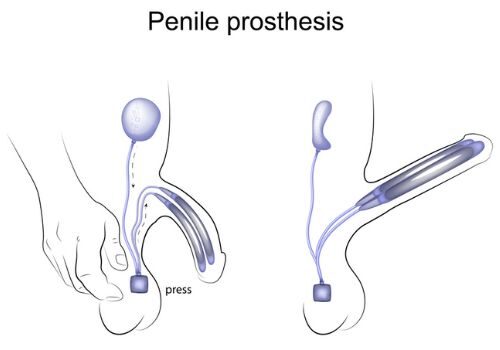
The field of sexual medicine has significantly advanced over the past two decades and so have contemporary penile prosthesis implantation techniques. Modern inflatable penile implants are remarkably durable — and yet, mechanical malfunction can still occur due to several factors:
- Component wear: Years after the initial implantation, the moving parts within the pump mechanism can break down. Tears and leaks may appear, which will keep the penis from becoming rigid enough or deflating properly.
- Infection: Although the infection rate is much lower with newer surgical techniques, it still happens. When they do, it is often necessary to remove the implant altogether and replace it.
- Fibrosis of the cavernosum: This condition develops from scarring within the corpora of the penis (the tissue that can become erect), and it can make it hard for the device to inflate properly. When this happens, the implant needs to be removed.
- Comorbidities: Some medical conditions can make erectile dysfunction harder to treat and increase the chances of the device not working as it should. According to a 2020 systematic review, poorly controlled diabetes can also increase the risk of infection after a revision surgery, further jeopardizing the integrity of the implant.
Key facts about penile implant revision surgery
In 1991, trailblazing urologist John Mulcahy pioneered a series of new techniques meant to improve the results of past IPP procedures. Ever since, surgical techniques have progressively become more sophisticated. Now, we can implement a good surgical plan from the very first consultation, which will help us maximize the chances of a good outcome.
Who is the ideal candidate for penile revision surgery?
Ideal candidates for penile implant revision are men who:
- Have clear problems with their current implant.
- Are in good general health, with no comorbidities, and cleared for surgery.
- Have realistic expectations regarding their implant’s performance, aesthetics, or comfort.
- Are dissatisfied with the results of their initial penile prosthetic surgery.
How is revision surgery performed?
Penile prosthetic implant revision typically involves:
- Evaluation and planning: Identifying the issues with the existing implant and planning the revision procedure.
- Removal of the old implant: Carefully removing the existing device while preserving the surrounding tissue.
- Replacement or repair: Inserting a new implant or repairing the existing one, depending on the condition.
- Closure: Ensuring proper placement and functionality before closing the surgical site.
The procedure is usually performed under anesthesia and takes about 2-3 hours.
What is its success rate?
Penile implant revision surgery is generally successful, although the overall success rate is slightly lower than with a first-time procedure.
The exact outcomes will be affected by many factors, such as the expertise of the surgical team and the reason for the revision surgery. For example, a small study conducted by the Department of Urology at Johns Hopkins checked the satisfaction of men who had a revision due to perceived deformities in the penis. They found that all patients in the study could have satisfactory sex within 6 months of follow-up after the revision.
What are its complications and risk factors?
While penile implant revision is generally safe, potential risks include:
- Infection, especially in cases involving prior implant infection.
- Scarring or tissue damage from previous surgeries.
- Device malfunction or need for future revisions.
At Tower Urology, our expertise minimizes these risks and ensures the best possible outcomes.
What is recovery like?
Recovery after penile implant revision typically includes:
- Post-surgery care: Swelling and discomfort can be managed with prescribed medications.
- Return to activities: Most patients can resume non-strenuous activities within 2 weeks.
- Sexual activity: Sexual activity is typically safe to resume after 6-8 weeks, depending on the individual’s healing process.
- Long-term benefits: The new or repaired implant provides reliable and consistent functionality, improving quality of life.
Are there other treatments to consider instead of penile implant revision surgery?
In some cases, alternative treatments may be considered, such as:
- Non-surgical therapies: For men experiencing mild dissatisfaction or temporary issues with an implant.
- Shockwave therapy: A non-invasive option to improve penile blood flow and sensitivity for men not requiring surgical intervention.
For men with significant complications or device failure, penile implant revision is often the most effective solution.
Why choose Tower Urology for treatment for penile implant revision surgery in Los Angeles
We get it: revision surgery may feel daunting. However, it often leads to improved outcomes and enhanced quality of life. Addressing complications or upgrading to a modern implant can restore confidence and comfort. At Tower Urology, we ensure that you feel supported and informed every step of the way.
For expert penile prosthetic implant revision care, contact Tower Urology today to schedule a consultation. Our dedicated team is here to help you achieve the best possible outcome and restore your sexual health.
Our approach is personal—we treat patients, not just pathology.
At Tower Urology, we specialize in complex penile implant revisions. Here’s what makes us unique:
- Expertise in revision surgery: Our surgeons have extensive experience handling even the most challenging cases.
- Advanced techniques: We use state-of-the-art tools and techniques to minimize tissue damage and ensure optimal outcomes.
- Customized care: Every procedure is tailored to the individual’s needs, anatomy, and goals.
- Comprehensive support: From pre-surgical planning to post-operative recovery, we provide compassionate, patient-centered care.
Tower Urology is easily accessible for patients across Southern California and the Los Angeles area, including Beverly Hills, Santa Monica, West Los Angeles, West Hollywood, Culver City, Hollywood, Venice, Marina del Rey, and Downtown Los Angeles.
Sources
Rescue Procedure: An Alternative to Complete Removal for Treatment of Infected Penile Prosthesis
https://www.auajournals.org/doi/abs/10.1016/S0022-5347%2817%2975546-2
Revision Washout Decreases Implant Capsule Tissue Culture Positivity: A Multicenter Study
https://www.auajournals.org/doi/abs/10.1016/j.juro.2007.08.168
Biofilm Formation on Clinically Noninfected Penile Prostheses
https://www.auajournals.org/doi/10.1016/j.juro.2006.04.034
Penile Prosthesis Cultures During Revision Surgery: A Multicenter Study
https://www.auajournals.org/doi/10.1097/01.ju.0000132141.48587.f1