Learning you have prostate cancer raises two questions right away: do you need treatment, and if so, how much? Some men can safely monitor their cancer. Others need surgery, radiation, or another approach.
Focal therapy for prostate cancer is a targeted treatment designed to destroy cancerous lesions within the prostate while preserving surrounding healthy tissue. This approach aims to reduce side effects often associated with whole-gland treatments like radical prostatectomy or radiation, such as erectile dysfunction and urinary incontinence. Tower Urology offers focal therapy as a minimally invasive option for men with localized, low-to-intermediate risk prostate cancer. The goal is to effectively manage the cancer while maintaining a higher quality of life for eligible patients.

Focal therapy treats the part of the prostate that contains cancer and leaves some of the gland untreated. For the right patient, this may lower the chance of lasting erectile problems or urine leakage. The tradeoff is that cancer may remain or develop elsewhere in the prostate. That is why regular follow-up with imaging, lab tests, and biopsies is essential.
HIFU, TULSA, and NanoKnife are three ways to destroy prostate tissue, and each one works differently. None has been proven to give every patient the same long-term cancer control as surgery or radiation.
What is focal therapy?
Focal therapy treats a selected area of the prostate, usually along with a margin of tissue around the known cancer. The treated area may be a small region, one side of the gland, or a larger portion.
Whole-gland ablation uses energy to treat most or all of the prostate. This is different from radical prostatectomy, which removes the prostate surgically. Treating more tissue may raise the risk of urinary and sexual side effects.
“Focal” describes how much tissue is treated. It is not a device name. HIFU and TULSA reach the prostate from different directions and can be used to treat different amounts of tissue. NanoKnife is generally used to treat a selected region.
How do focal therapy treatments work?
All three treatments destroy prostate tissue in the planned area, but they use different types of energy and reach the prostate in different ways.
HIFU: focused ultrasound delivered through the rectum
High-intensity focused ultrasound (HIFU) uses concentrated sound waves to heat and destroy targeted prostate tissue. The energy comes from a probe placed in the rectum, so no abdominal incision is needed.
Prostate size, calcium deposits, and cancer location can affect whether HIFU can safely reach the intended area. Ideally, the prostate should weigh less than 40 grams, and the distance from the rectum to the front (anterior) wall of the prostate should be less than 4 cm.
TULSA: MRI-guided ultrasound delivered through the urethra
Transurethral ultrasound ablation (TULSA) delivers ultrasound energy from a device placed in the urethra, the tube that carries urine out of the body. MRI images and temperature monitoring guide the heating of the planned treatment area.
Unlike HIFU, TULSA can treat either a selected area or a larger portion of the prostate. The procedure is done inside an MRI machine, so it requires specialized MRI equipment. MRI safety restrictions, certain implants, and calcium deposits in the prostate may affect whether you can have it.
NanoKnife: treatment with electrical pulses
NanoKnife uses a technique called irreversible electroporation (IRE). Thin needles are placed through the skin between the scrotum and anus. Electrical pulses create tiny openings in cell membranes, destroying cells in the planned area. This is different from treatments that mainly heat or freeze tissue.
Despite its name, NanoKnife does not use a surgical blade, and it does not remove the prostate. It still requires needle placement and anesthesia, and it can injure nearby structures. It does not guarantee preservation of nerves, erections, or bladder control.
Who may be a candidate for focal therapy for prostate cancer?
Focal therapy may be an option for selected patients with a clearly defined area of clinically significant cancer, meaning cancer that is more likely to grow or spread if left untreated. Candidates often have limited intermediate-risk disease, such as some Gleason 3+4 cancers (also called Grade Group 2).
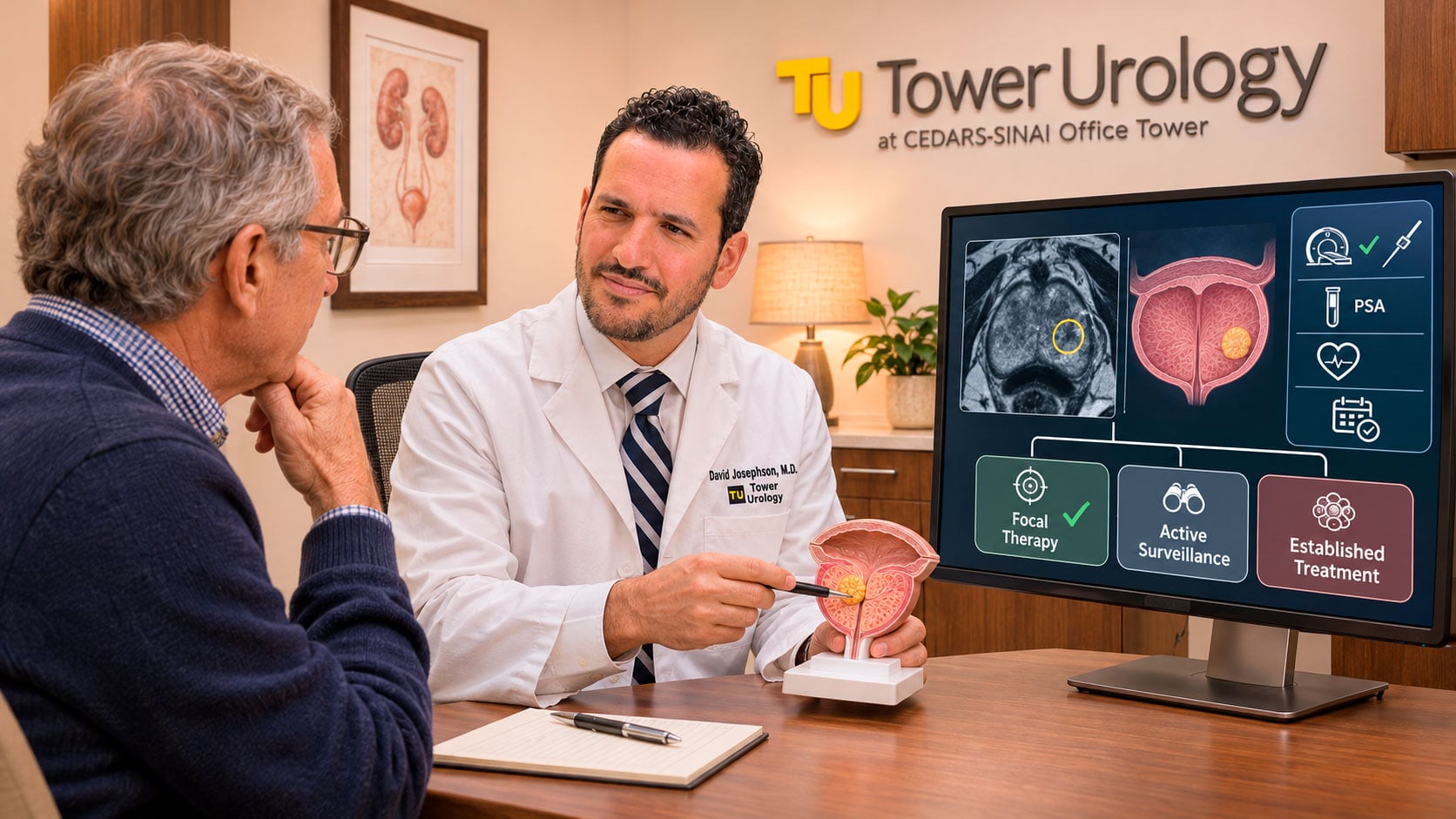
Your doctor will also consider:
- The grade, amount, and location of the cancer.
- Whether MRI and biopsy findings agree about where the cancer is.
- Whether significant cancer is present elsewhere in the prostate.
- Your PSA level, prostate size, and any evidence of cancer outside the gland.
- Your urinary symptoms, sexual function, overall health, and treatment goals.
- Your willingness to have regular testing and possibly additional treatment.
For many patients with low-risk cancer, active surveillance is the preferred first approach because it avoids unnecessary treatment. Focal therapy is generally not appropriate for cancer that has spread outside the prostate, for widespread aggressive cancer within the gland (Grade Group 3 to 5), or for patients who cannot complete follow-up. High-risk disease usually calls for established treatments, and ablation is not a routine substitute.
Why are MRI and biopsy both important?
Prostate cancer can appear in more than one spot. MRI helps locate suspicious areas, but it cannot show every cancer cell or replace a biopsy.
An evaluation generally includes a high-quality 3 Tesla prostate MRI with contrast, targeted biopsies of any suspicious areas, and systematic samples from other parts of the gland. Some patients need additional mapping biopsies. The biopsy report shows whether cancer was found, its grade, and how much cancer is present.
Your doctor will review these results along with your PSA history and exam. Additional scans are done when your cancer risk level calls for them. A single spot on MRI does not, on its own, mean that focal treatment is right for you.
What are the benefits and the tradeoffs of focal therapy?
For selected patients, treating a smaller area may lower the risk of lasting urine leakage and erection problems compared with treatments that affect the whole gland. These procedures do not use radiation, and recovery is often shorter than after prostate removal.
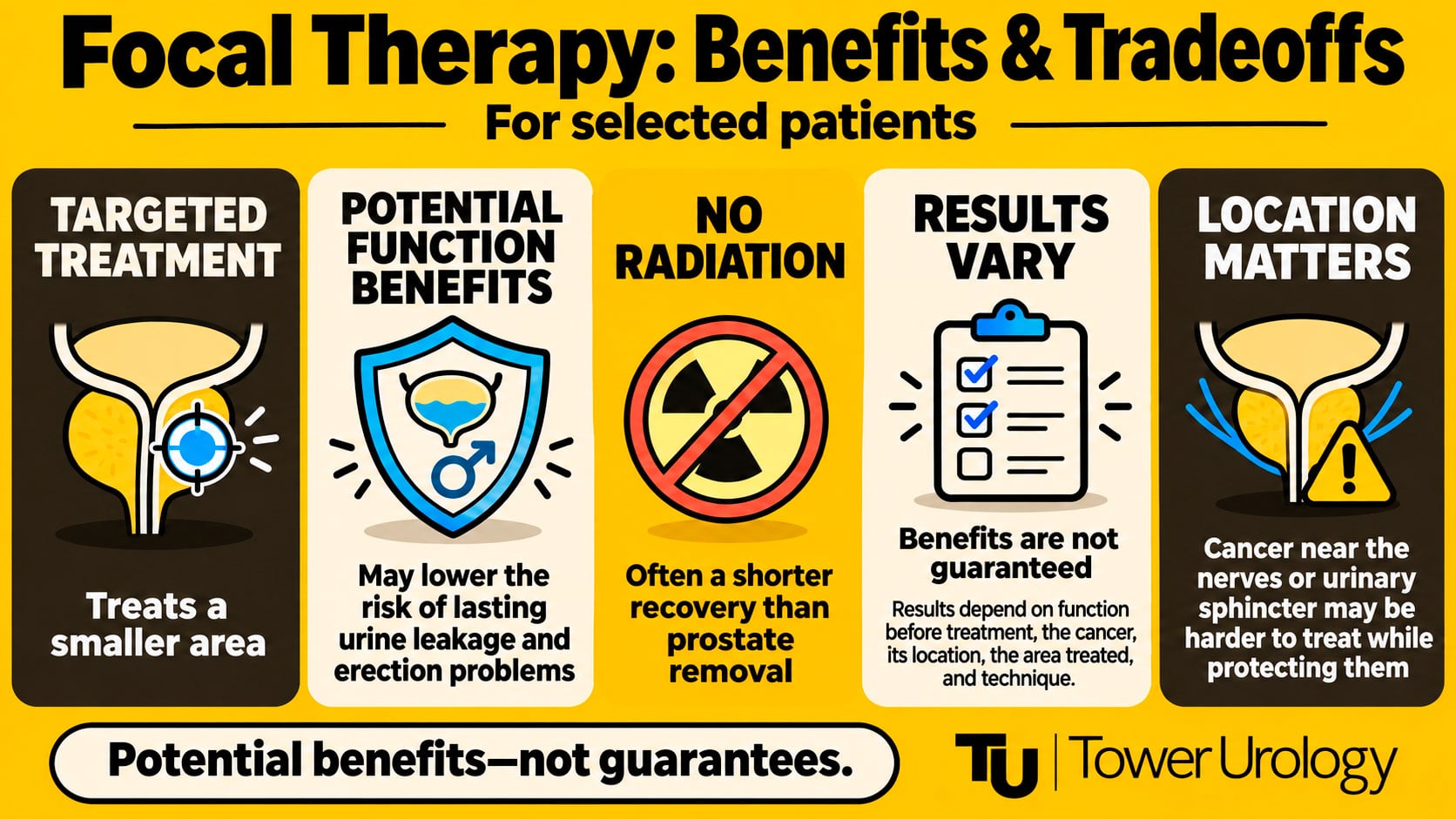
These are potential benefits, not guarantees. Results depend on your urinary and sexual function before treatment, the cancer and its location, the area treated, and the technique used. A cancer close to the nerves or the urinary sphincter (the muscle that helps hold in urine) may be harder to treat while still protecting those structures.
What are the risks and recovery needs?
All of these treatments require anesthesia, and most, if not all, patients go home the same day. A temporary urinary catheter is always needed afterward. How long you need it depends on the procedure and your recovery.
Possible side effects include:
- Burning, urgency, or frequent urination.
- Blood in the urine or semen, discomfort, or temporary swelling.
- Urinary infection or difficulty emptying the bladder.
- Scarring or narrowing of the urine passage (a urethral stricture), which may require another procedure.
- Urine leakage, erection problems, or changes in ejaculation.
Uncommon but serious complications can include severe infection, injury to nearby organs, or a fistula, which is an abnormal connection between the urinary tract and the rectum. Risks differ by treatment and can be higher if you have had radiation or other prostate procedures. Your doctor will go over the risks that apply to your plan, and when you can return to work, exercise, and sexual activity.
How well does focal therapy control cancer?
Studies show that these treatments can destroy targeted cancer and preserve urinary and sexual function in many carefully selected patients. However, cancer may remain in the treated area or be found elsewhere in the prostate.
Long-term evidence for focal therapy is less mature than it is for surgery or radiation. Studies also use different patient groups, treatment methods, and definitions of success, which makes them hard to compare. A lower PSA or a reassuring MRI does not prove that all of the cancer is gone.
Focal therapy has not been shown to be equivalent to radical prostatectomy or radiation for preventing cancer spread or death in all patients. Major guidelines still consider prostate ablation investigational. Depending on the method and guideline, they emphasize careful counseling and treatment through clinical trials or prospective registries that track patient outcomes over time. Ask your doctor whether a trial or registry is available to you.
Will I still need PSA tests and biopsies after focal therapy?
Because some prostate tissue remains, your PSA usually will not drop to zero. Monitoring generally includes regular PSA tests, repeat prostate MRI, and a planned follow-up biopsy, often around 6 to 12 months after treatment. The exact schedule depends on your procedure and your results.
Follow-up biopsies may sample both the treated area and the untreated prostate, and more biopsies may be needed later. PSA tests and MRI alone cannot reliably rule out cancer that remains or comes back.
What if cancer remains or returns after focal therapy?
Depending on the grade, location, and extent of the cancer, options may include monitoring a low-risk finding, another focal treatment, surgery, or radiation. Repeat treatment is not suitable for everyone.
Surgery or radiation may still be possible after ablation. However, the earlier treatment can change the tissue and make later treatment more complex. Your doctor should discuss this with you before your first procedure.
Making a decision about focal therapy
Bring your MRI, biopsy report, and PSA history to your consultation. Reviewing them together can help you understand whether focal therapy is a reasonable option for you and how it compares with active surveillance, surgery, or radiation in your case.
Why choose Tower Urology for prostate cancer care?

Several of our urologists have been recognized by Newsweek as among the nation’s top prostate cancer surgeons, reflecting our team’s surgical expertise and patient-centered care.
Tower Urology’s board-certified urology team has led cancer treatment for over two decades, with specialists trained in all aspects of prostate health.
Tower Urology is a proud affiliate of Cedars-Sinai Medical Center, ranked #1 in California and #2 nationwide by U.S. News & World Report. This partnership reflects our dedication to delivering the highest standard of urologic care alongside Los Angeles’s best urologists.
Our years of experience and access to Cedars-Sinai’s world-class facilities ensure our exceptional, innovative urologic care positions Tower Urology as a Southern California leader.
FAQs about Focal Therapy for Prostate Cancer

No. Focal therapy means treating a selected part of the prostate, and HIFU is one way to do it. TULSA and NanoKnife are other approaches.
No single option is best for every patient. The location of the cancer, your prostate anatomy, prior treatment, other medical conditions, and the expertise available all matter. Strong long-term studies comparing these technologies are limited.
Possibly, if testing shows that you are an appropriate candidate. Some patients are better served by active surveillance, and others need surgery or radiation. Fewer side effects are important, but they must be weighed against the risk the cancer poses.
Many patients keep good function, but none of these treatments can guarantee it. Your risk depends on your function before treatment and on how much tissue is treated and where.
Yes. Repeat biopsies are an important part of monitoring after focal therapy, even when PSA and MRI results are reassuring.
Some patients whose cancer comes back only in the prostate may be considered for salvage ablation, meaning ablation used after an earlier treatment. This requires a separate evaluation, confirmation that the cancer has returned, and testing to check whether it has spread. Risks are generally higher than with first-time treatment.
No. FDA clearance allows a device to be marketed for prostate tissue ablation. It does not prove that the treatment provides the same long-term cancer control or survival as surgery or radiation.
Coverage varies by procedure, insurer, and plan. Before scheduling, confirm prior authorization, facility fees, and your expected out-of-pocket costs.
-
EAU Prostate Cancer Guidelines, 2026, treatment chapter, §6.2.4: selection, limitations, complications, and research setting. HIFU/cryotherapy focal treatment is restricted to prospective registries; other ablation approaches are supported by well-designed prospective trials. https://uroweb.org/guidelines/prostate-cancer/chapter/treatment
-
EAU Prostate Cancer Guidelines, 2026, treatment chapter, §6.2.4: selection, limitations, complications and research setting. HIFU/cryotherapy focal treatment is restricted to prospective registries; other ablation approaches to well-designed prospective trials. https://uroweb.org/guidelines/prostate-cancer/chapter/treatment
-
Scheltema et al., median five-year focal IRE outcomes, BJU International: prospective cohort follow-up shows both functional preservation and a meaningful need for further cancer treatment. Observational data do not prove equivalence to radical therapy. https://pubmed.ncbi.nlm.nih.gov/36495481/
-
TULSA systematic review/meta-analysis, 2026: heterogeneous outcomes and limited long-term cancer control evidence. Its pooled results are deliberately not presented as a patient-specific https://pubmed.ncbi.nlm.nih.gov/42864969/
-
FDA NanoKnife device record, March 24, 2026; device-specific labeling must be checked if adding detailed regulatory claims. https://www.accessdata.fda.gov/scripts/cdrh/cfdocs/cfpmn/pmn.cfm?ID=K253198